Competitive Analysis AI Prompts: 12 Proven Templates + Practical Guide
If you ask AI, “Analyze my competitors,” you usually get a weak answer. It stays generic, misses the market context, and gives broad advice you already know.
Good competitive analysis ai prompts are more specific. They tell the model what market to study, which competitors matter, what evidence to use, what framework to follow, and what output format you want. That matches the main prompt-writing advice from OpenAI and Google: give clear instructions, add context, define constraints, and ask for a structured output.
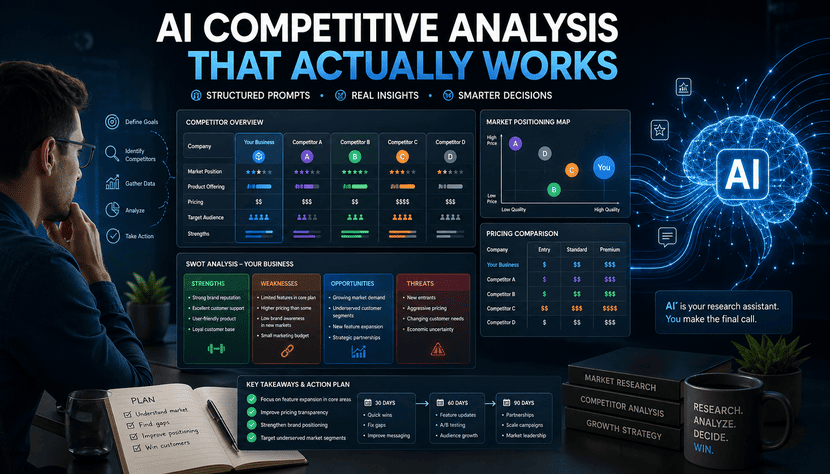
Good competitor research also follows a process. HubSpot, Asana, and Similarweb all recommend starting with goals, identifying direct and indirect competitors, gathering data on products, pricing, marketing, audience, and reviews, then using frameworks like SWOT or comparison matrices to turn research into action.
Why most prompts fail
Weak prompts are too broad. They ask the AI to “analyze competitors” without saying which companies matter, what should be compared, what sources to use, or what a useful answer looks like. Strong professional frameworks solve that problem by following a simple order: identify competitors, gather data, compare products and marketing, assess strengths and weaknesses, and turn the findings into strategic actions. Prompt engineering guidance adds the execution layer: put instructions first, separate context clearly, be specific, and define the output format.
A practical prompt should always include these parts:
- The business goal
- The list of competitors
- The market or audience
- The dimensions to compare
- The source material or raw notes
- The exact output format
- The decision you want to make from the result
A simple workflow that actually works
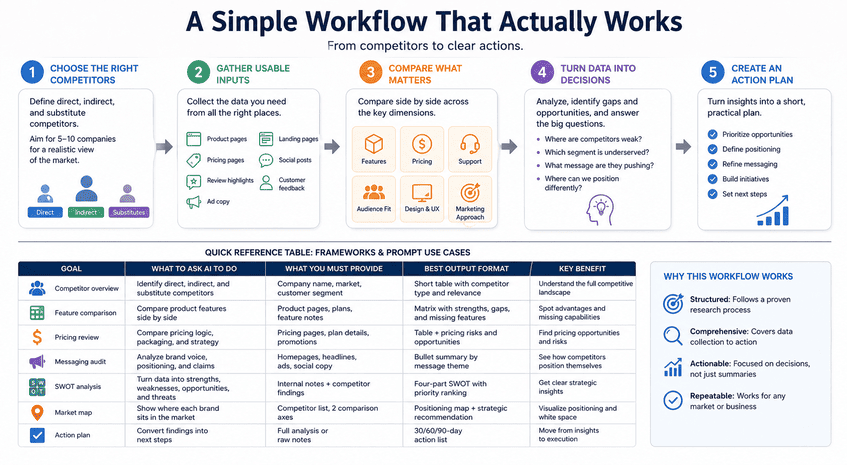
The most useful guides follow a very similar workflow. First, define direct, indirect, and substitute competitors. Next, gather market facts. Then compare features, pricing, positioning, and marketing. After that, run a SWOT view, map your place in the market, and turn the result into a short action plan. This is much more effective than asking for a generic “competitor summary.”
Step 1: Choose the right competitors
Start with 5 to 10 companies if possible. Include a mix of direct rivals, indirect alternatives, and substitutes. This gives you a realistic picture of the market instead of a narrow comparison.
Step 2: Gather usable inputs
Collect product pages, pricing pages, review highlights, ad copy, landing pages, social posts, and customer feedback. BDC recommends looking not only at product and price, but also place, promotion, positioning, reputation, people, and partnerships.
Step 3: Compare what matters
Asana recommends comparing product features, pricing, support, audience fit, design, ease of use, and marketing approach. In practice, that means the AI should not just list facts. It should compare them side by side.
Step 4: Turn data into decisions
The final output should answer business questions such as: Where are competitors weak? Which segment is underserved? What message are they pushing? Where can we position differently? A good prompt forces the model to end with actions, not summaries.
Quick reference table
The table below turns the main professional frameworks into prompt use cases you can apply right away. The categories come from feature comparison, marketing comparison, SWOT, market mapping, and the classic product-price-place-promotion structure.
| Goal | What to ask the AI to do | What you must provide | Best output format |
|---|---|---|---|
| Competitor overview | Identify direct, indirect, and substitute rivals | Company name, market, customer segment | Short table with competitor type and relevance |
| Feature comparison | Compare product features side by side | Product pages, plans, feature notes | Matrix with strengths, gaps, and missing features |
| Pricing review | Compare pricing logic, packaging, and discount strategy | Pricing pages, plan details, free trial notes | Table plus pricing risks and opportunities |
| Messaging audit | Analyze brand voice, positioning, and claims | Homepages, headlines, ads, social copy | Bullet summary by message theme |
| SWOT analysis | Turn market data into strengths, weaknesses, opportunities, and threats | Internal notes plus competitor findings | Four-part SWOT with priority ranking |
| Market map | Show where each brand sits in the market | Competitor list, 2 comparison axes | Positioning map plus strategic recommendation |
| Action plan | Convert findings into next steps | Full analysis or raw notes | 30/60/90-day action list |
Prompt writing rules that improve output fast
The best prompt engineering advice is simple: place the instruction first, separate context with clear markers, describe the desired result in plain language, and show the exact format you want back. For factual business work, low randomness is better than creative output, and vague wording should be replaced with precise requests.
Here are the rules worth following every time:
- Put the task at the top.
- Separate your notes with markers like
###or triple quotes. - Ask for a specific structure such as table, SWOT, or action plan.
- Tell the model to flag missing data instead of guessing.
- Ask it to separate facts from assumptions.
- Keep the language plain and the output short enough to use.
Ready-to-use prompt templates
These templates are built from professional competitor analysis frameworks and prompt engineering best practices. Replace the bracketed parts with your own data.
12 best professional competitive analysis AI prompts
Below are the most useful ai prompts for competitive analysis. They are written to be practical, not flashy. Copy them, replace the brackets, and use them with your real inputs.
1. Competitor landscape prompt
Best for: identifying who really matters in the market
CopyAct as a senior market research analyst.

Help me map the competitive landscape for [company/product/service].

Context:
- Industry: [insert]
- Target audience: [insert]
- Product category: [insert]
- Main problem we solve: [insert]
- Region: [insert]

Tasks:
1. Identify likely direct competitors
2. Identify indirect competitors
3. Identify substitute solutions
4. Explain how each competitor overlaps with us
5. Rank them by threat level

Output format:
- table with columns: competitor, type, audience overlap, product overlap, threat level, why they matter
- short summary of the top 5 competitors
Why it works:
HubSpot and Similarweb both stress that competitive research starts with correctly identifying direct and indirect competitors. If you get this wrong, the rest of the analysis is weak.
2. SWOT analysis prompt
Best for: quick strategic comparison
CopyAct as a strategy consultant.

Create a SWOT analysis for these competitors in [market]:
[competitor list]
Our company:
[brief description]
Use the following inputs if available: – product pages – reviews – pricing pages – public messaging – known strengths/weaknesses Output: – one SWOT table per competitor – one combined SWOT summary for our company vs the market – top 5 strategic actions we should take next
Why it works:
SWOT remains one of the simplest and most useful competitive analysis formats because it turns scattered information into decisions. HubSpot, Asana, and Similarweb all recommend it as a core framework.
3. Feature comparison prompt
Best for: product and offer benchmarking
CopyAct as a product marketing analyst.

Compare our product with these competitors:
[competitor list]
Our product:
[insert]
Analyze: – core features – premium features – onboarding experience – support – integrations – ease of use – standout advantages – missing capabilities Output: – comparison matrix table – top 3 areas where we win – top 3 areas where we are behind – recommended product or messaging fixes
Why it works:
Asana recommends comparing products feature by feature so you can see what matters most to buyers and where your offer is weaker or stronger.
4. Pricing analysis prompt
Best for: reviewing price position and packaging
CopyAct as a pricing strategist.

Analyze the pricing models of our competitors and compare them to ours.

Our pricing:
[insert]
Competitor pricing pages or notes:
[insert]
Review: – starting price – packaging tiers – free trial or free plan – discount strategy – enterprise pricing signals – feature gating – perceived value Output: – pricing comparison table – pricing risks for our company – opportunities to reposition or repackage our offer – 3 test ideas for pricing or packaging
Why it works:
HubSpot highlights pricing as a major part of competitive analysis because it affects positioning, sign-up behavior, and profitability.
5. Messaging analysis prompt
Best for: finding weak and strong positioning
CopyAct as a brand strategist.

Analyze the messaging of our company and these competitors:
[list]
For each brand, review: – homepage headline – value proposition – key benefits – proof points – CTA language – target audience signals – emotional tone – brand voice Output: – table comparing each brand’s positioning – repeated claims across the market – messaging gaps no one owns clearly – 5 sharper positioning angles for our brand
Why it works:
Asana recommends analyzing marketing, website copy, and brand story, not just product features. This is where many companies find real differentiation.
6. Customer review mining prompt
Best for: learning what customers really care about
CopyAct as a customer insights analyst.

Review these customer reviews from our competitors:
[paste reviews or summaries]
Tasks: – group the most common complaints – group the most common praise points – identify feature expectations – identify switching reasons – identify trust concerns – identify wording customers use repeatedly Output: – complaint themes table – praise themes table – top unmet needs in the market – how our company can respond in product, copy, or sales messaging
Why it works:
Similarweb recommends using reviews and customer feedback to uncover what competitors are doing well and where customers are disappointed. That often reveals the best openings in the market.
7. SEO competitor analysis prompt
Best for: organic search strategy
CopyAct as an SEO strategist.

Analyze our SEO position against these competitors:
[list]
Our site:
[insert]
Review: – keyword overlap – content themes – likely search intent focus – pages that appear to drive traffic – content gaps – bottom-of-funnel keyword opportunities – weak areas in our content strategy Output: – keyword gap table – content opportunity list – 90-day SEO action plan
Why it works:
Both Asana and Similarweb point to SEO tools and website analysis as key parts of competitor research, especially when you want to see how competitors attract demand.
8. Paid media and offer prompt
Best for: ad strategy review
CopyAct as a performance marketing analyst.

Analyze the paid marketing approach of these competitors:
[list]
Focus on: – ad angles – offers – lead magnets – CTA patterns – landing page structure – urgency tactics – trust signals – retargeting clues if visible Output: – table of likely ad angles by competitor – repeated offers in the market – weak offers we can avoid – 5 better campaign angles for our brand
Why it works:
Competitive analysis is not only about who exists. It is also about what tactics they use to win clicks and conversions. HubSpot specifically notes that competitor analysis can uncover new marketing strategies and tactics worth testing.
9. Social media competitive prompt
Best for: channel and content comparison
CopyAct as a social media strategist.

Compare our social media presence with these competitors:
[list]
Evaluate: – platform focus – posting frequency – content formats – engagement patterns – recurring content themes – community tone – promotion vs education balance – strongest content hooks Output: – channel comparison table – top content patterns by competitor – what we should stop, start, and continue – 10 social content ideas based on market gaps
Why it works:
Asana includes social and marketing strategy as a core part of competitive analysis, and HubSpot recommends using competitor data to benchmark performance and improve strategy.
10. Market gap prompt
Best for: finding whitespace opportunities
CopyAct as a market opportunity strategist.

Based on this competitor research:
[paste findings]
Identify: – underserved audience segments – weak offers in the market – repeated blind spots in competitor positioning – customer needs that are mentioned but not solved well – channels or formats competitors ignore Output: – ranked opportunity list – why each opportunity matters – expected difficulty level – fastest opportunity to test in the next 30 days
Why it works:
HubSpot and Similarweb both emphasize that one of the biggest benefits of competitive analysis is uncovering untapped opportunities, not just copying competitors.
11. Win-loss prompt
Best for: sales and buying decision analysis
CopyAct as a B2B competitive intelligence analyst.

Use the following sales notes, call summaries, objections, and lost-deal reasons to analyze why prospects choose competitors over us.

Inputs:
[paste notes]
Tasks: – group the main competitor-related objections – identify recurring reasons we lose – identify recurring reasons we win – separate product issues from pricing issues, trust issues, and messaging issues – recommend fixes Output: – win-loss table – top competitor threats – 5 battlecard updates for sales – 5 messaging changes for marketing
Why it works:
Competitive analysis becomes more useful when it includes real buyer language and sales objections, not just public website research. Similarweb also recommends using direct customer and sales insights where possible.
12. Executive summary prompt
Best for: turning raw research into decisions
CopyAct as a senior strategy advisor.

Turn this competitive analysis research into a short executive report for leadership.

Research:
[paste notes]
Requirements: – simple language – no filler – focus on what matters – separate facts from assumptions – include immediate actions and longer-term actions Output: 1. executive summary 2. key threats 3. biggest market opportunities 4. where we are behind 5. where we can clearly win 6. next 30, 60, and 90 day actions
Why it works:
Competitive research is only valuable if it leads to action. Asana makes this point clearly: don’t just collect data, use it to improve your strategic plan.
Common mistakes to avoid
Here are the mistakes that make most competitive analysis ai prompts weak:
- asking AI to analyze competitors without giving names or data
- mixing pricing, product, SEO, brand, and sales into one messy prompt
- letting AI guess facts
- treating competitor claims as truth
- copying competitor strategy instead of finding gaps
- skipping customer reviews and buyer objections
- stopping at summary instead of asking for action
OpenAI recommends iterative refinement, and Google recommends using clear structure plus examples when needed. That is exactly how to avoid weak outputs here. Source Source
Best reusable prompt formula
If you want to write your own ai prompts for competitive analysis, use this template:
CopyAct as a [role].

Analyze [company/product/market] against [competitors].

Context:
- industry: [insert]
- audience: [insert]
- region: [insert]
- goal: [insert]

Use these inputs:
[paste notes, URLs, reviews, pricing, feature lists, sales notes]
Framework: [SWOT / pricing / messaging / SEO / feature matrix / social analysis] Rules: – do not invent facts – separate evidence from assumptions – keep it concise – prioritize practical recommendations Output: – table – summary – top insights – recommended actions
Infographic description
Title: Competitive Analysis AI Prompts: 12 Practical Templates
Layout idea:
A clean vertical infographic split into 4 blocks.
1. Research
- Competitor landscape prompt
- Review mining prompt
- Win-loss prompt
2. Compare
- SWOT prompt
- Feature comparison prompt
- Pricing analysis prompt
3. Market visibility
- SEO competitor prompt
- Paid media prompt
- Social media prompt
4. Strategy
- Messaging analysis prompt
- Market gap prompt
- Executive summary prompt
Footer formula:
Role + Market Context + Inputs + Framework + Output = Better Competitive Analysis Prompt
FAQ
What are competitive analysis ai prompts?
They are prompts designed to help AI analyze competitors, market positioning, pricing, customer sentiment, SEO, messaging, and growth opportunities in a structured way.
Why are competitive analysise ai prompts better when they are specific?
Because AI performs better when the prompt includes context, constraints, and a clear output format. That is a core recommendation from both OpenAI and Google.
What are the best ai prompts for competitive market analysis?
The best ones usually focus on one area at a time: competitor mapping, SWOT, pricing, reviews, SEO, or market gaps. The prompts in this article are built that way.
Can I use ai prompts for competitive analysis without market data?
Yes, but the result will be weaker. AI is most useful when you feed it real inputs like reviews, pricing pages, feature notes, or sales objections.
Which prompt is best for finding market gaps?
Use the market gap prompt. It helps you identify underserved segments, weak offers, and missing positioning angles.
Which prompt is best for pricing analysis?
Use the pricing analysis prompt. It compares tiers, free plans, feature gating, discounts, and value signals.
Which prompt is best for B2B competitor research?
The win-loss prompt and messaging analysis prompt are especially strong for B2B because they connect sales objections with market positioning.
Should I trust AI to do the whole analysis alone?
No. Use AI as an accelerator, not a final authority. It is best for organizing, comparing, summarizing, and generating action ideas from real inputs. You still need to verify facts and make the final call.
Final takeaway
The best competitive analysis ai prompts are not dramatic. They are structured.
If you give AI the market, the competitors, the evidence, and the framework, it can save a lot of time and produce genuinely useful analysis. If you give it a vague question, it will give you vague strategy.
Use the prompts above one by one. Start with competitor mapping, then move into SWOT, pricing, messaging, reviews, and market gaps. That is how you turn AI into a practical research assistant instead of a generic content machine.