
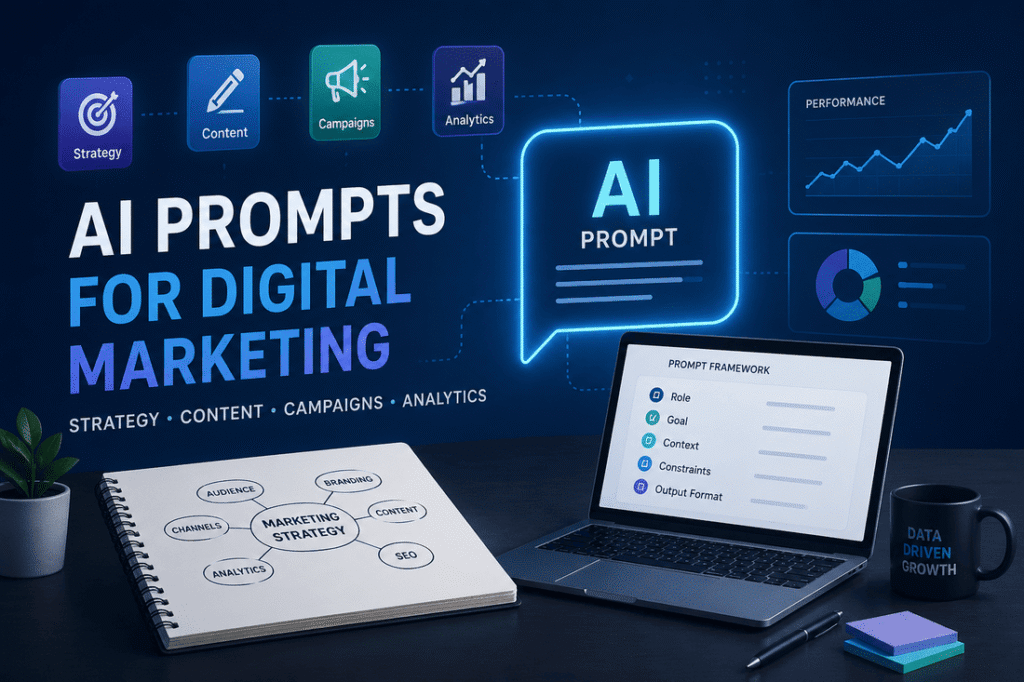
18 Professional AI Prompts for Digital Marketing
If you want better results from AI, don’t ask vague questions. Give clear instructions, useful context, and a specific format. That is what turns random output into work you can actually use. Both OpenAI and Google recommend clear instructions, context, constraints, and examples when prompting AI. HubSpot also reports that marketers get better results when they experiment and add context instead of relying on one short prompt.
This article gives you the 18 Professional AI Prompts for Digital Marketing for real digital marketing work. They are written in simple language, easy to adapt, and designed to help with planning, content, analysis, campaigns, and reporting. If you need AI prompts for content marketing, AI prompts for marketing analysis, AI prompts for marketing strategy, AI prompts for marketing planning, or AI prompts for marketing campaigns, start here.
HubSpot says text-based content creation is one of the top ways marketers use AI today, and its survey highlights two things that matter most in prompting: experimentation and context. In plain English, better input usually means better output.
What makes a good marketing prompt?
A good prompt has five parts:
- Role — tell AI who it should act like
- Goal — explain what you need
- Context — add product, audience, channel, offer, or data
- Constraints — set word count, tone, format, and do/don’t rules
- Output format — ask for a table, bullets, sections, or a final draft
This structure matches the main advice from OpenAI and Google: be specific, add context, define constraints, and ask for the format you want.
Quick summary table
| # | Prompt type | Best use |
|---|---|---|
| 1 | Marketing strategy | Full strategic direction |
| 2 | Marketing plan | 30/60/90-day execution |
| 3 | Campaign strategy | Full-funnel campaign build |
| 4 | Content marketing strategy | Content system tied to goals |
| 5 | Content calendar | Publishing workflow |
| 6 | SEO article brief | Better writer briefs |
| 7 | Blog writing | Cleaner expert articles |
| 8 | Social strategy | Platform-specific planning |
| 9 | Paid ads | Ad copy and testing |
| 10 | Landing page copy | Conversion-focused pages |
| 11 | Email sequence | Lifecycle campaigns |
| 12 | Marketing analysis | Performance diagnosis |
| 13 | Competitor analysis | Market gap detection |
| 14 | Buyer persona | Better audience understanding |
| 15 | Funnel audit | Conversion improvements |
| 16 | Positioning | Sharper differentiation |
| 17 | Marketing report | Stakeholder-ready reporting |
| 18 | A/B testing roadmap | Optimization planning |
1. Full marketing strategy prompt
Best for: building a complete strategy, not just ideas
CopyAct as a senior digital marketing strategist.

Create a complete marketing strategy for [company/product/service].

Business overview:
- Product/service: [insert]
- Target audience: [insert]
- Market category: [insert]
- Price point: [insert]
- Core offer: [insert]
- Business goal: [insert]

Your task:
Build a practical marketing strategy that includes:
1. target audience segments
2. customer pain points and desired outcomes
3. positioning statement
4. key messaging pillars
5. channel strategy
6. content strategy
7. funnel stages
8. lead generation approach
9. retention opportunities
10. KPI recommendations

Constraints:
- Keep the strategy realistic for a [small team / startup / agency / enterprise]
- Avoid generic advice
- Prioritize actions by impact and difficulty
- Use simple business language

Output format:
- executive summary
- strategic priorities
- channel plan table
- 90-day action plan
- KPI table
Copy
2. Marketing planning prompt
Best for: turning goals into an execution plan
CopyAct as a head of marketing.

Create a 90-day marketing plan for [brand] with the goal of [goal].

Context:
- Industry: [insert]
- Audience: [insert]
- Offer: [insert]
- Budget: [insert]
- Team size: [insert]
- Main channels: [insert]

Include:
- monthly priorities
- weekly actions
- content deliverables
- campaign milestones
- budget allocation ideas
- performance metrics
- risks and blockers

Make the plan practical, lean, and execution-focused.

Output format:
1. 90-day overview
2. month-by-month plan
3. weekly sprint plan
4. priority table
5. KPI dashboard recommendation
3. Campaign strategy prompt
Best for: professional AI prompts for marketing campaigns
CopyAct as a senior campaign strategist.

Build a full-funnel campaign for [product/service] targeting [audience].

Campaign goal: [lead generation / sales / signups / awareness / demo bookings]
Offer: [insert]
Timeframe: [insert]
Budget: [insert]

Create:
- campaign concept
- core message
- audience segments
- channel mix
- creative angles
- landing page angle
- email support sequence
- retargeting logic
- KPIs by stage
- optimization ideas

Constraints:
- Keep it measurable
- Focus on commercial outcomes
- Avoid vague branding language

Output format:
- campaign brief
- channel plan table
- messaging matrix
- KPI table
- launch checklist
Copy
4. Content marketing strategy prompt
Best for: strong AI prompts for content marketing
CopyAct as a senior content marketing strategist.

Create a content marketing strategy for [brand] in [industry].

Goal: [traffic / leads / authority / SEO growth / pipeline]
Audience: [insert]
Offer: [insert]
Buying cycle: [short / medium / long]

Build a strategy that includes:
- content pillars
- target search intent
- funnel mapping
- topic clusters
- lead magnet ideas
- distribution plan
- repurposing workflow
- CTA strategy

Constraints:
- Prioritize content that supports business goals
- Avoid empty awareness content
- Focus on content that can rank, convert, or support sales

Output format:
1. strategy summary
2. content pillars table
3. topic cluster table
4. funnel content map
5. 30-day publishing plan
Copy
5. Content calendar prompt
Best for: structured content planning
CopyAct as a content director.

Build a 30-day cross-channel content calendar for [brand].

Inputs:
- audience: [insert]
- product/service: [insert]
- offer: [insert]
- key themes: [insert]
- channels: [LinkedIn, blog, email, Instagram, X, YouTube]
- posting frequency: [insert]

For each content asset, include:
- title or topic
- content format
- target funnel stage
- main CTA
- distribution channel
- repurposing idea

Keep the calendar balanced between educational, authority-building, conversion, and trust content.

Output as a table.
6. SEO article brief prompt
Best for: writing better briefs before content production
CopyAct as an SEO content strategist.

Create a professional article brief for the keyword: [keyword].

Brand context:
- website type: [insert]
- target audience: [insert]
- product/service relevance: [insert]
- search intent goal: [insert]

Include:
- primary keyword
- secondary keywords
- user intent
- angle
- suggested title options
- H1/H2/H3 structure
- internal link ideas
- CTA recommendation
- FAQ section ideas
- common mistakes to avoid

Make the brief useful for a real writer, not generic.

Output format:
- keyword summary
- SEO brief table
- article outline
- CTA recommendation
7. Professional blog writing prompt
Best for: cleaner, more expert article drafts
CopyAct as a senior B2B content writer.

Write a professional, easy-to-read article about [topic] for [target audience].

Requirements:
- sound human and credible
- use simple language
- avoid filler and clichés
- include clear examples
- explain ideas in a practical way
- write for readers who want actionable advice
- maintain a confident but natural tone

Structure:
- title
- introduction
- clear H2 sections
- examples
- table
- FAQ
- conclusion

Do not sound robotic or over-optimized.
8. Social media strategy prompt
Best for: brand-led social planning
CopyAct as a senior social media strategist.

Create a social media strategy for [brand] targeting [audience].

Goal: [awareness / engagement / demand generation / leads / community]
Platforms: [insert]
Brand tone: [insert]

Build:
- platform-specific goals
- content themes
- post types
- hook styles
- CTA types
- posting frequency
- engagement approach
- content-to-conversion path

Constraints:
- Each platform should have a different role
- Avoid repeating the same content everywhere
- Keep the strategy aligned with business goals

Output format:
1. strategy summary
2. platform role table
3. content theme table
4. 2-week sample plan
9. Paid ads prompt
Best for: professional ad messaging and testing
CopyAct as a performance marketing copywriter.

Create paid ad copy for [product/service].

Audience: [insert]
Pain point: [insert]
Offer: [insert]
Main benefit: [insert]
Platform: [Meta / Google / LinkedIn / TikTok]

Generate:
- 10 headlines
- 5 primary text variations
- 5 CTA lines
- 3 creative angles
- 3 test hypotheses

Constraints:
- clear and direct language
- avoid hype
- avoid unrealistic claims
- make the copy conversion-focused

Output format:
- headline table
- body copy table
- testing recommendations
10. Landing page copy prompt
Best for: conversion-focused page structure
CopyAct as a senior conversion copywriter.

Write landing page copy for [offer/product/service].

Target audience: [insert]
Traffic source: [ads / organic / email / social]
Goal: [book calls / buy / sign up / request demo]

Structure the page with:
- headline
- subheadline
- pain/problem section
- benefits
- features translated into outcomes
- objections
- proof
- CTA blocks
- FAQ

Constraints:
- simple language
- short sections
- strong clarity
- no corporate jargon
- focus on why this matters to the buyer

Output format:
- full page structure
- copy blocks by section
- CTA variations
Copy
11. Email sequence prompt
Best for: lifecycle and campaign email flows
CopyAct as a senior email marketing strategist.

Create a professional email sequence for [offer/product].

Sequence type: [welcome / nurture / webinar / abandoned cart / promo / reactivation]
Audience: [insert]
Goal: [insert]
Tone: [insert]

For each email include:
- email objective
- subject line
- preview text
- full body copy
- CTA
- reason this email exists in the sequence

Constraints:
- each email must have a clear role
- avoid repetition
- keep the writing human and concise
- write for conversion, not just opens

Output format:
- sequence overview
- email-by-email table
- full copy
12. Marketing analysis prompt
Best for: strong AI prompts for marketing analysis
CopyAct as a senior marketing analyst.

Analyze the following performance data:
[data]
Business context: – goal: [insert] – campaign type: [insert] – audience: [insert] – channels used: [insert] Your job: – identify what worked – identify what underperformed – explain likely reasons – spot funnel drop-offs – detect budget inefficiencies – recommend the top 5 next actions Constraints: – do not just summarize the numbers – interpret them in a business context – rank recommendations by expected impact Output format: 1. executive summary 2. insight table 3. issue diagnosis 4. recommended actions table 5. test ideas Copy
13. Competitor analysis prompt
Best for: sharper positioning
CopyAct as a competitive marketing strategist.

Analyze these competitors: [list competitors]

Review:
- positioning
- offers
- pricing signals
- messaging
- content themes
- CTAs
- social proof
- funnel approach

Then compare them with [our brand].

Your task:
- identify competitor strengths
- identify weak spots
- identify messaging gaps in the market
- recommend 5 positioning opportunities for our brand

Output format:
- comparison table
- market gap summary
- positioning recommendations
14. Buyer persona prompt
Best for: creating better messaging inputs
CopyAct as a B2B marketing strategist and customer researcher.

Create a detailed buyer persona for [product/service].

Include:
- role/title
- company type
- goals
- pain points
- buying triggers
- objections
- decision criteria
- common questions
- preferred channels
- content they trust
- messaging that will resonate
- messaging to avoid

Make the persona realistic and commercially useful.

Output format:
- persona summary
- pain points table
- buying decision table
- messaging guide
15. Funnel audit prompt
Best for: improving conversion paths
CopyAct as a growth marketer.

Audit this funnel:
- traffic source: [insert]
- landing page: [insert]
- lead capture step: [insert]
- nurture step: [insert]
- sales step: [insert]

Goal: identify friction, weak messaging, and missed conversion opportunities.

For each stage, analyze:
- clarity
- relevance
- trust
- urgency
- CTA strength
- user objections
- likely drop-off points

Output format:
1. funnel audit summary
2. stage-by-stage table
3. top 7 improvement recommendations
4. quick wins vs bigger changes
16. Positioning prompt
Best for: clearer brand differentiation
CopyAct as a positioning strategist.

Help position [brand/product/service] more clearly in the market.

Inputs:
- category: [insert]
- target audience: [insert]
- main competitors: [insert]
- current positioning: [insert]
- strengths: [insert]
- common customer problem: [insert]

Create:
- a sharper positioning statement
- 3 differentiation angles
- key message pillars
- proof points we should emphasize
- weak positioning phrases to avoid
- homepage messaging suggestions

Keep it clear, sharp, and commercially strong.
17. Marketing report prompt
Best for: client-ready or team-ready reports
CopyAct as a marketing performance manager.

Turn the following raw results into a professional monthly marketing report:
[data]
Audience for report: [client / CEO / internal team / marketing manager] Include: – top-line summary – wins – losses – what changed – what needs attention – next month priorities – recommended experiments Constraints: – simple language – no empty jargon – focus on decisions, not just numbers Output format: – executive summary – KPI table – insights section – action plan section
18. A/B testing and optimization prompt
Best for: systematic improvement
CopyAct as a CRO specialist.

Based on this asset:
[paste ad / email / landing page / page section / funnel summary]
Create a professional A/B testing roadmap. For each test include: – what to test – why it matters – hypothesis – priority level – expected impact – success metric – implementation difficulty Constraints: – suggest practical tests first – avoid random ideas – tie each test to a likely conversion problem Output format: – prioritized test table – quick wins – deeper experiments
How to make these prompts even more professional
If you want stronger output, always add these 7 inputs:
| Input | Why it matters |
|---|---|
| Audience | Improves relevance |
| Offer | Keeps the output commercial |
| Goal | Helps AI prioritize |
| Channel | Changes tone and structure |
| Constraints | Reduces generic output |
| Brand voice | Makes the result sound consistent |
| Data/examples | Makes output more realistic |
A simple upgrade line you can add to almost any prompt is:
CopyBefore writing the final answer, identify the 3 biggest strategic risks or blind spots in the request, then adjust the output to reduce them.
That one line usually makes the answer feel much more senior.
Professional prompt formula
If you want to build your own, use this structure:
CopyAct as [role].

Your task is to [goal].

Context:
- business: [insert]
- audience: [insert]
- offer: [insert]
- channel: [insert]
- goal: [insert]

Requirements:
- [requirement 1]
- [requirement 2]
- [requirement 3]

Constraints:
- [what to avoid]
- [tone]
- [format]
- [length]

Output format:
- [section 1]
- [section 2]
- [table]
- [FAQ]
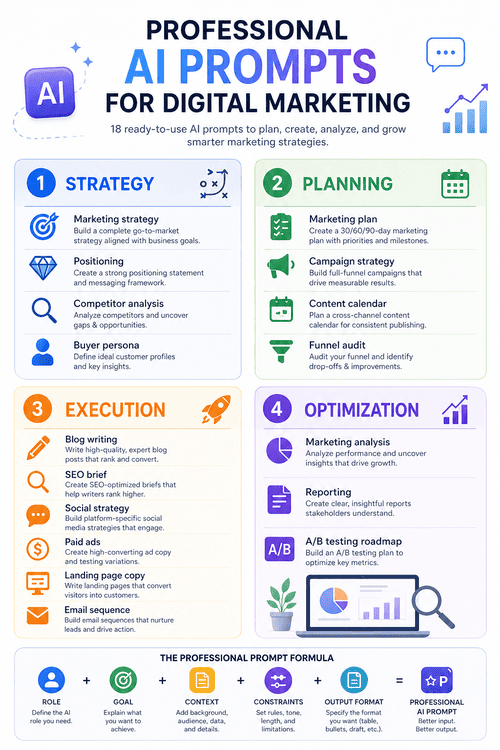
Infographic description
Title: Professional AI Prompts for Digital Marketing
Layout idea:
A clean infographic split into 4 blocks:
1. Strategy
- Marketing strategy
- Positioning
- Competitor analysis
- Buyer persona
2. Planning
- Marketing plan
- Campaign strategy
- Content calendar
- Funnel audit
3. Execution
- Blog writing
- SEO brief
- Social strategy
- Paid ads
- Landing page copy
- Email sequence
4. Optimization
- Marketing analysis
- Reporting
- A/B testing roadmap
Footer formula:
Role + Goal + Context + Constraints + Output Format = Professional Prompt
FAQ
What makes a prompt more professional?
A professional prompt gives AI a role, business context, clear goals, constraints, and a structured output format. It sounds like a real brief, not a quick request.
Are these good for agencies?
Yes. These are especially useful for agencies, freelancers, consultants, and internal marketing teams because they are built around strategy, execution, and reporting.
Which prompts are best for AI prompts for content marketing?
The best ones are:
- content marketing strategy
- content calendar
- SEO article brief
- professional blog writing
Which prompts are best for AI prompts for marketing analysis?
Use:
- marketing analysis
- competitor analysis
- funnel audit
- marketing report
Which prompts are best for AI prompts for marketing strategy?
Use:
- full marketing strategy
- positioning
- buyer persona
- competitor analysis
- campaign strategy
Which prompts are best for AI prompts for marketing planning?
Use:
- marketing planning
- campaign strategy
- content calendar
- A/B testing roadmap
Which prompts are best for AI prompts for marketing campaigns?
Use:
- campaign strategy
- paid ads
- landing page copy
- email sequence
- funnel audit

Anderson Paola
Articles: 19Related Posts



One comment
Comments are closed.
[…] planning your customer acquisition channels, you can also adapt TechStarts’ professional digital marketing prompts to build a local marketing plan around your actual service areas, customer types, and competitors […]