AI Prompts for Property Management: Practical Prompts You Can Use Today
Property management is full of repetitive work: replying to leads, answering tenant questions, handling maintenance, writing notices, updating owners, and keeping records clean. AI can help with all of that, but only if you give it clear instructions. A good prompt saves time, improves consistency, and helps your team sound professional without sounding robotic. Recent industry reporting shows AI adoption in property management rose sharply, and early users are seeing meaningful time savings in communication and operations.
Source: NAR — Generative AI for Property Managers: A Beginner’s Guide: https://www.nar.realtor/commercial/create/generative-ai-for-property-managers-a-beginners-guide
Why this matters
The best property management prompts do three things: they give the AI a role, they provide context, and they define the exact output you want. That matches widely used prompt-writing guidance: put instructions first, be specific about tone and format, and tell the model what to do instead of only saying what to avoid.
Quick statistics
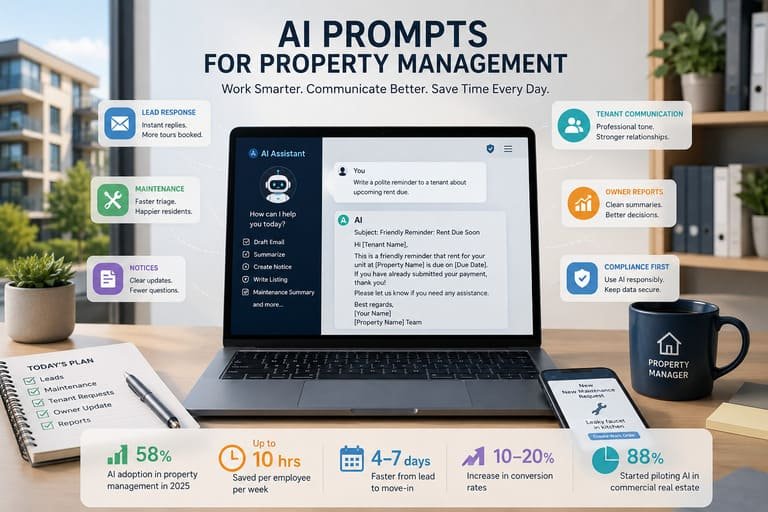
- AI adoption in property management reportedly jumped from 20% in 2024 to 58% in 2025.
- Property management teams are saving up to 10 hours per employee per week with AI-supported workflows.
- Lead-to-move-in time has decreased by 4–7 days in early adoption cases.
- Conversion rates have improved by 10–20% in reported multifamily use cases.
- In commercial real estate, 88% of investors, owners, and landlords had started piloting AI, yet only 5% said they had achieved all program goals, which shows that using AI well matters as much as using it at all. Source
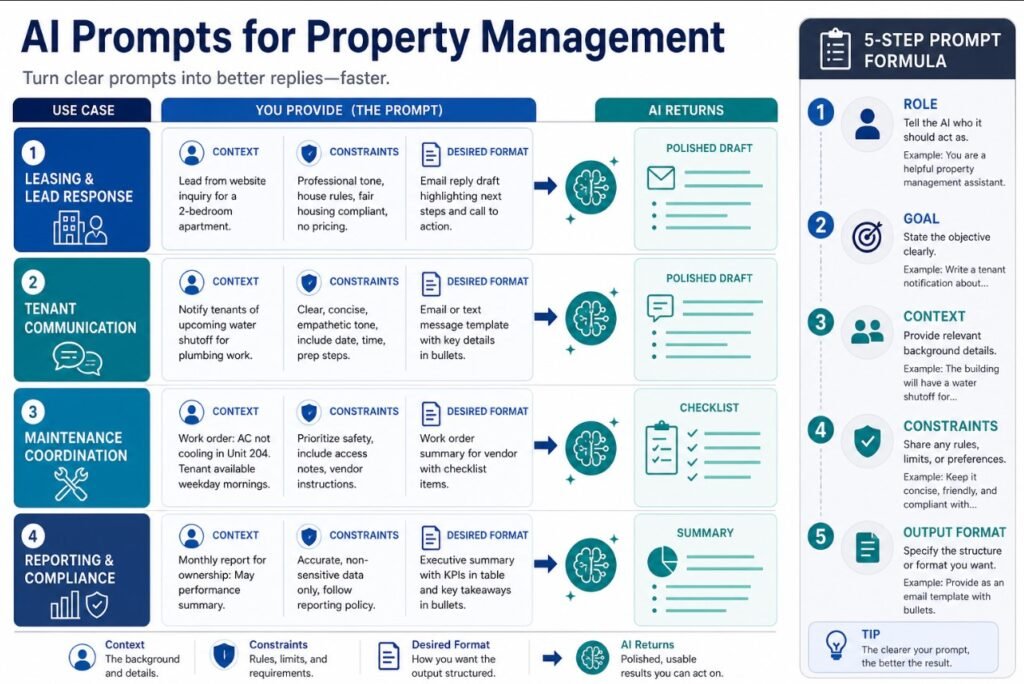
The simple formula for a strong property management prompt
Use this structure every time:
- Role — Tell the AI who it is.
- Goal — Say what you want done.
- Context — Add property, tenant, lease, or workflow details.
- Constraints — Set tone, legal caution, length, and what to avoid.
- Output format — Ask for email, SMS, checklist, table, report, script, or summary.
Example:
You are a senior property manager. Draft a short, polite, professional email to a tenant about a scheduled plumbing repair at a 120-unit apartment community. Keep it under 140 words. Use simple language. Include date, arrival window, access instructions, and a clear call to reply with concerns. Do not mention legal conclusions.
That format works because it is clear, specific, and easy for AI to follow.
Before you use AI in property management
Do not paste private or regulated information into public AI tools. Avoid full bank details, Social Security numbers, medical details, screening data, or anything that could create privacy or fair housing risk. Use AI for drafting, summarizing, organizing, and first-pass communication, but keep a human in the loop for legal, leasing, screening, and compliance-sensitive decisions. Source
Best professional prompts at a glance
| Task | Best use | Copy-ready prompt starter | Output |
|---|---|---|---|
| Lead response | Reply faster to new inquiries | “Write a friendly first response to a rental lead…” | Email or SMS |
| Listing description | Create better ads | “Write a rental listing for this unit…” | Listing copy |
| Late rent reminder | Stay firm but respectful | “Draft an empathetic but firm rent reminder…” | Email/SMS |
| Maintenance triage | Organize repair requests | “Turn this tenant message into a maintenance summary…” | Work order |
| Lease renewal | Improve retention | “Write a lease renewal offer with options…” | Email letter |
| Owner reporting | Save admin time | “Summarize this month’s portfolio performance…” | Report |
| Review response | Protect brand tone | “Respond to this resident review professionally…” | Public reply |
| Policy notice | Send clear updates | “Draft a resident notice about the policy change…” | Notice |
| Move-out instructions | Reduce confusion | “Write simple move-out instructions…” | Checklist email |
| Vendor coordination | Speed up repairs | “Turn this issue into a vendor briefing…” | Work order summary |
12 practical AI prompts for property managers
Below are copy-and-paste prompts you can use right away.
1) New leasing inquiry response
CopyYou are an experienced leasing manager.

Write a warm, professional response to a new rental inquiry.

Property details:
- Property name: [PROPERTY NAME]
- Unit type: [UNIT TYPE]
- Rent: [RENT]
- Location: [CITY/AREA]
- Available date: [DATE]
- Key amenities: [AMENITIES]

Prospect message:
[PASTE MESSAGE]

Instructions:
- Thank the prospect for the inquiry
- Answer the main question clearly
- Invite them to book a tour
- Offer 2 next-step options
- Keep the tone friendly and efficient
- Keep it under 160 words

Output:
- Subject line
- Email body
- Short SMS version
Why it works: It gives the AI all the missing context and asks for two usable formats.
2) Follow-up for a prospect who went quiet
CopyYou are a professional leasing agent.

Write a follow-up message to a prospect who asked about a unit but has not replied for [NUMBER] days.

Context:
- Property: [PROPERTY NAME]
- Unit: [UNIT TYPE]
- Rent: [RENT]
- Original inquiry date: [DATE]
- Last contact: [DATE]

Instructions:
- Be polite and not pushy
- Create urgency without sounding aggressive
- Mention one strong feature of the property
- Ask one simple question that is easy to answer
- Keep the email under 120 words

Output:
- Subject line
- Email
- SMS version under 320 characters
3) Rental listing description
CopyYou are a property marketing specialist.

Write a clear, attractive rental listing for this unit.

Details:
- Property type: [APARTMENT/HOUSE/CONDO]
- Bedrooms/Bathrooms: [X/X]
- Square footage: [SIZE]
- Rent: [RENT]
- Deposit: [DEPOSIT]
- Location highlights: [LOCATION]
- Amenities: [AMENITIES]
- Pet policy: [POLICY]
- Parking: [DETAILS]
- Availability: [DATE]

Instructions:
- Use simple language
- Focus on benefits, not hype
- Avoid clichés like “won’t last long” unless justified
- Do not invent features
- Keep it between 120 and 180 words

Output:
- Headline
- Main description
- 5 bullet highlights
This prompt is useful because listing creation is already one of the most practical AI use cases in property management.
4) Empathetic but firm late rent reminder
CopyYou are a senior property manager.

Draft an empathetic but firm rent reminder for a resident with an overdue balance.

Resident details:
- First name: [NAME]
- Property: [PROPERTY NAME]
- Amount due: [AMOUNT]
- Original due date: [DATE]
- Grace period status: [STATUS]
- Payment options: [OPTIONS]
- Contact method for questions: [CONTACT]

Instructions:
- Be respectful and professional
- Do not sound threatening
- State the amount due and the date clearly
- Encourage immediate action
- Mention how to contact the office
- Do not give legal advice

Output:
- Email version
- SMS version
- Phone script version under 80 words
5) Turn a tenant message into a maintenance work order
CopyYou are a maintenance coordinator for a property management company.

Turn the tenant message below into a clean maintenance work order.

Tenant message:
[PASTE MESSAGE]

Instructions:
- Extract the issue
- Identify the likely trade category
- Mark urgency as emergency, urgent, routine, or cosmetic
- List probable causes
- List tools or materials the technician may need
- Write one follow-up question if details are missing
- Use a professional internal tone

Output format:
- Problem summary
- Unit/location
- Priority level
- Trade category
- Suggested next step
- Follow-up question
This reflects one of the clearest AI workflows in property management: faster maintenance handling and better work-order quality.
6) Resident notice about scheduled maintenance
CopyYou are a property manager.

Write a resident notice about scheduled maintenance.

Details:
- Property: [PROPERTY NAME]
- Work type: [PLUMBING/HVAC/ELECTRICAL/etc.]
- Date: [DATE]
- Time window: [TIME]
- Unit access needed: [YES/NO]
- Preparation steps for residents: [STEPS]
- Contact: [CONTACT INFO]

Instructions:
- Use plain language
- Be calm and clear
- Explain what residents need to do
- Add one sentence on appreciation for cooperation
- Keep it under 150 words

Output:
- Email notice
- SMS reminder
- Lobby/posting version
7) Lease renewal offer
CopyYou are a retention-focused property manager.

Write a lease renewal offer for a current resident.

Resident details:
- Name: [NAME]
- Current rent: [CURRENT RENT]
- Proposed renewal options: [OPTIONS]
- Lease end date: [DATE]
- Resident positives: [ON-TIME PAYMENTS / LONG-TERM / LOW MAINTENANCE / etc.]

Instructions:
- Sound professional and appreciative
- Clearly explain the options
- Emphasize value and convenience
- Invite questions
- Avoid pressure tactics
- Keep it concise

Output:
- Email version
- Short call script
8) Move-out instructions that reduce confusion
CopyYou are a property manager.

Write move-out instructions for a resident who gave notice.

Details:
- Property: [PROPERTY NAME]
- Move-out date: [DATE]
- Key return method: [METHOD]
- Cleaning expectations: [DETAILS]
- Utility instructions: [DETAILS]
- Forwarding address request: [DETAILS]
- Inspection process: [DETAILS]

Instructions:
- Use simple, step-by-step language
- Avoid legal conclusions
- Make the checklist easy to scan
- Keep the tone helpful, not cold

Output:
- Email
- Numbered checklist
9) Owner monthly report summary
CopyYou are a portfolio manager preparing an owner update.

Use the data below to write a simple monthly summary for the property owner.

Data:
- Occupancy: [X%]
- Delinquency: [X]
- Leasing traffic: [X]
- New leases: [X]
- Renewals: [X]
- Maintenance volume: [X]
- Major issues: [DETAILS]
- Budget variances: [DETAILS]

Instructions:
- Write for a busy owner
- Highlight wins, risks, and actions
- Use plain English
- Do not overstate performance
- Keep it to 3 short sections

Output:
- Executive summary
- Key metrics bullets
- Recommended next actions
AI is especially helpful for drafting owner reports and reducing time spent on repetitive documentation.
10) Public response to an online review
CopyYou are a property manager responding publicly to a resident review.

Review:
[PASTE REVIEW]

Instructions:
- Be professional and calm
- Thank the reviewer
- Do not argue
- Acknowledge the concern without admitting legal fault
- Invite the resident to continue the conversation privately
- Keep it under 100 words

Output:
- Public response
- Private follow-up message
11) Rewrite a messy internal note into a clean incident summary
CopyYou are an operations manager.

Turn the rough note below into a factual incident summary.

Raw note:
[PASTE NOTE]

Instructions:
- Keep only facts
- Remove emotional wording
- Put events in time order
- Identify missing facts that should be verified
- Do not guess or add new facts

Output:
- Incident summary
- Timeline
- Missing information checklist
12) Create a resident FAQ from repeated questions
CopyYou are a resident experience manager.

Create a resident FAQ based on these repeated questions and answers.

Content:
[PASTE EMAILS, CHAT LOGS, OR NOTES]

Instructions:
- Group similar questions together
- Rewrite in plain language
- Keep answers short
- Flag anything that should be reviewed by legal or management
- End with a “contact us” section

Output:
- FAQ title
- 8 to 12 questions and answers
- Topics that need human review
The prompts that usually deliver the best results
If you only save five prompts, make them these:
- Lead response prompt — because speed matters in leasing
- Maintenance triage prompt — because messy requests waste technician time
- Late rent reminder prompt — because tone matters
- Lease renewal prompt — because retention protects revenue
- Owner summary prompt — because reporting takes time every month
Those five cover leasing, operations, collections, retention, and owner communication, which are some of the most practical AI use cases already showing value in the industry.
Common mistakes to avoid
- Writing prompts that are too vague
- Forgetting to define tone
- Pasting private data into the tool
- Letting AI invent missing facts
- Using AI output without human review
- Asking for “something short” instead of giving a word limit
- Saying only what not to do instead of what to do
These mistakes line up with standard prompt-engineering guidance: be specific, put instructions first, define the format, and tell the model the desired behavior clearly.
A simple prompt template your team can reuse
CopyYou are a [ROLE].

Your task is to [GOAL].

Context:
[IMPORTANT DETAILS]

Rules:
- Tone: [TONE]
- Length: [LENGTH]
- Audience: [AUDIENCE]
- Must include: [KEY POINTS]
- Must avoid: [RISKS / SENSITIVE AREAS]
- If information is missing, ask up to [NUMBER] clarifying questions

Output:
[EMAIL / SMS / TABLE / CHECKLIST / REPORT / SCRIPT]
This reusable structure is often enough to improve output quality immediately.
FAQ
Can AI replace a property manager?
No. AI is best for drafting, summarizing, organizing, and speeding up routine communication. Human judgment is still needed for sensitive resident issues, legal review, leasing decisions, and compliance.
What is the best first AI use case for property management?
Start with communication and documentation: lead replies, maintenance summaries, resident notices, owner updates, and listing descriptions. These are low-risk, high-frequency tasks that save time quickly.
How much time can AI save a property management team?
Industry reporting says teams are saving up to 10 hours per employee per week in some early adoption cases, though results depend on workflow quality and rollout discipline.
Should I paste lease documents or tenant data into AI?
Only if your tool, policy, and legal process allow it. Be very careful with personal, financial, screening, and sensitive resident data. For many teams, the safer approach is to remove identifying details first and use AI for structure and drafting only.
Why do some AI prompts fail?
Usually because they are too vague. If you do not define the role, context, tone, length, and format, the output becomes generic. Better prompts create better results.
What should every property management AI policy include?
At minimum: privacy rules, banned data types, required human review, brand tone guidelines, approved use cases, and escalation rules for legal or fair housing issues. That helps teams move faster without creating unnecessary risk.
Final takeaway
AI is not magic. In property management, it works best when the job is clear, the prompt is specific, and a human reviews the result. Start with the tasks your team repeats every day. Build a small library of approved prompts. Keep private data out. Check tone and compliance before sending. Done well, AI can save time, improve consistency, and make your team faster without making your communication sound fake.