5 AI Prompt Templates for Better Social Content
This guide to ai prompts for social media is for social media managers who want faster content creation, better social media marketing results, stronger social media posts, and a reliable set of ai social media prompts.
Good prompts save time because they tell the model exactly what to do. A weak prompt gives you generic copy. A strong prompt gives you clear angles, better hooks, sharper structure, and text that sounds closer to your brand. The basic rule is simple: give the AI a role, a goal, context, limits, and a clear output format. That approach matches widely recommended prompt-writing best practices: be specific, provide context, and refine prompts iteratively.
Why this matters right now
The opportunity is large. In 2025, the world reached 5.24 billion active social user identities, up 4.1% year over year, and the average internet user spent 2 hours and 21 minutes per day on social platforms. That means better prompts are not a small optimization; they improve work in one of the biggest attention channels on the internet. Source
AI adoption is already practical, not experimental. SurveyMonkey reports that 51% of marketing teams use AI to optimize content, and 40% use it for research. In other words, teams are already using AI where speed and clarity matter most.
Social also drives buying decisions. Sprout Social found that 76% of users said social content influenced a purchase in the previous six months, rising to 90% for Gen Z. The same research found that 41% of Gen Z now turn to social first for search.
The simple prompt formula that works
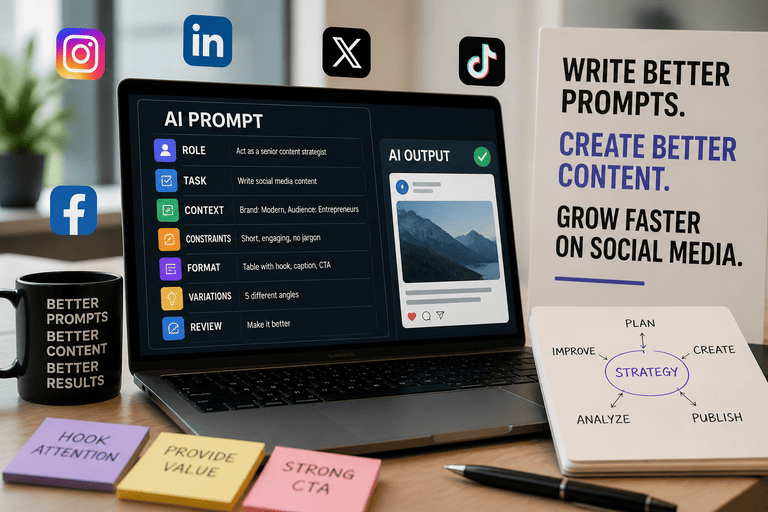
Use this 7-part structure:
- Role — Tell the AI who it is
Example: “Act as a senior brand strategist.” - Task — Say exactly what you need
Example: “Write three caption options for a product launch.” - Context — Add brand, audience, offer, platform, and goal
Example: “Brand voice is smart, warm, and direct. Audience is busy founders.” - Constraints — Set limits
Example: “No jargon. No emojis. Under 120 words.” - Format — Define the output shape
Example: “Return a table with hook, caption, CTA, and hashtag ideas.” - Quality bar — Explain what “good” means
Example: “Make it sound useful, specific, and confident.” - Variation — Ask for options
Example: “Give me 5 angles: educational, bold, data-led, story-led, and contrarian.”
Mini infographic
CopyTHE HIGH-PERFORMING PROMPT STACK

[ROLE]
Who the AI should be

   ↓

[TASK]
What it must produce

   ↓

[CONTEXT]
Brand + audience + offer + platform

   ↓

[CONSTRAINTS]
Length + tone + banned words + CTA rules

   ↓

[FORMAT]
Table / bullets / script / captions

   ↓

[VARIATIONS]
3-5 different angles

   ↓

[REVIEW]
Ask it to improve the weakest line
Copy
What strong prompts usually include
- A clear audience
- One goal per prompt
- A platform-specific format
- Tone guidance
- Length limits
- A call to action
- A request for multiple versions
- A short self-check step
Professional prompt table
| Use case | Copy-paste prompt |
|---|---|
| Monthly plan | “Act as a senior content strategist. Build a 4-week posting plan for [brand] for [platform]. Audience: [audience]. Goal: [goal]. Include 3 content pillars, 4 weekly themes, and 12 post ideas. For each idea, add hook, format, CTA, and reason it should work. Keep it practical and tied to audience pain points.” |
| Caption writing | “Write 5 caption options for [product/service] for [platform]. Audience: [audience]. Goal: [clicks/leads/comments]. Tone: [tone]. Keep each version under [length]. Make each caption different in angle: one direct, one story-led, one bold, one educational, and one curiosity-driven. End with a soft CTA.” |
| Short video script | “Create a [30/45/60]-second short-form video script for [topic]. Start with a strong hook in the first sentence. Structure: hook, problem, insight, example, CTA. Tone: [tone]. Audience: [audience]. Avoid filler. Make every line easy to say out loud.” |
| Carousel outline | “Create a 7-slide carousel outline about [topic]. Audience: [audience]. Goal: saves and shares. For each slide, write headline, one supporting point, and a short visual direction. Make slide 1 highly scroll-stopping and the final slide a clear CTA.” |
| Repurposing | “Turn this source material into 8 platform-ready ideas: [paste article/transcript/notes]. Give me 2 short videos, 2 carousels, 2 text posts, and 2 comment prompts. Keep the original idea intact but adapt the framing for fast consumption.” |
| Brand voice rewrite | “Rewrite the draft below in our brand voice. Brand voice: [3-5 traits]. Audience: [audience]. Platform: [platform]. Keep the main idea, remove weak lines, tighten flow, and improve the opening. Return 3 versions: safe, stronger, and bold.” |
| Launch campaign | “Create a 10-day launch messaging plan for [offer]. Include teaser phase, launch day, proof phase, objection handling, and deadline push. For each day, provide angle, hook, caption starter, CTA, and suggested creative format.” |
| Comment/reply bank | “Build a reply bank for comments on [topic/product]. Create short, natural responses for praise, objections, pricing questions, feature questions, skepticism, and inactive leads. Tone: helpful, calm, confident. Do not sound robotic.” |
| A/B hook testing | “Generate 20 hooks for [topic] for [platform]. Split them into 5 styles: direct, curiosity, contrarian, benefit-led, and story-led. Keep each hook under [X] words. Prioritize clarity over cleverness.” |
| Performance review | “Analyze these post results and tell me what to do next: [paste metrics]. Find patterns by hook, format, topic, CTA, and posting time. Then suggest 10 next tests ranked by likely impact.” |
The best ready-to-use prompts
1) Prompt for post ideas that do not feel repetitive
CopyAct as a senior strategist for a modern brand.

Create 15 original post ideas for [brand] on [platform].

Audience:
[describe audience]
Offer:
[describe product/service]
Goal:
[awareness / engagement / leads / sales]
Content pillars:
[pillar 1]
[pillar 2]
[pillar 3]
Requirements: – Ideas must be specific, not generic – Avoid repeating the same angle – Mix educational, opinion-led, proof-led, behind-the-scenes, and community formats – Add a one-line hook for each idea – Add the best format for each idea – Add a simple CTA – Keep the language clear and human Return as a table with: Idea | Hook | Format | Why it should work | CTA
2) Prompt for captions that sound more human
CopyWrite 5 caption options for [offer] for [platform].

Audience:
[audience]
Desired tone:
[for example: warm, sharp, expert, calm]
What the audience cares about:
[list 3-5 points]
What we want them to do: [CTA] Rules: – No hype words – No clichés – No filler – Clear opening line – Natural rhythm – Easy to read on mobile – Keep each caption under [X] words Give me: 1. one straightforward version 2. one story-led version 3. one educational version 4. one bold opinion version 5. one conversion-focused version
3) Prompt for short video scripts
CopyCreate 10 short video concepts for [brand/topic].

Audience:
[audience]
Goal:
[reach / engagement / leads]
Platform:
[platform]
Each concept must include: – a hook in the first line – a simple talking-point structure – one visual suggestion – one CTA Make the concepts feel native to the platform. Avoid corporate language. Prioritize ideas that are easy to film quickly.
4) Prompt for repurposing one idea into many assets
CopyTake this source content and turn it into a multi-format content pack:

Source:
[paste text / transcript / webinar notes]
Create: – 3 short video ideas – 3 carousel ideas – 3 text-based post ideas – 2 email subject lines – 5 comment prompts to drive discussion Rules: – Keep the original message consistent – Make each asset feel native to its format – Highlight practical value – Remove unnecessary detail
5) Prompt for analytics-based improvement
CopyAct as a performance-focused content lead.

Review these results:
[paste metrics]
Identify: – best-performing topics – strongest hooks – best formats – weak CTAs – likely reasons for low performers Then provide: – 5 insights – 5 fixes – 10 new test ideas – 3 experiments to run next week Base recommendations only on the data provided. If data is missing, say what is missing.
A fast workflow you can use every week
- Ask AI for 20 angles around one audience problem.
- Pick the best 5 manually.
- Turn those into captions, carousels, and short video scripts.
- Rewrite the final draft in brand voice.
- Check facts, tone, and claims.
- Publish.
- Feed results back into a performance-review prompt.
This matters because AI is good at speed and variation, but people are still better at taste, accuracy, and brand judgment.
Common mistakes that make prompts weak
- Asking for too much in one prompt
- Giving no audience details
- Forgetting the platform
- Using vague words like “make it better”
- Not setting word limits
- Accepting the first draft without editing
- Ignoring performance data
- Forgetting to ask for multiple angles
Quick statistics snapshot
| Metric | Number | Why it matters |
|---|---|---|
| Active social user identities worldwide | 5.24B | Huge audience size for brands |
| Year-over-year growth | 4.1% | The space is still expanding |
| Average daily time spent | 2h 21m | Attention is still significant |
| Users influenced to buy by social content | 76% | Social directly affects revenue |
| Gen Z influenced to buy | 90% | Younger buyers are especially responsive |
| Marketing teams using AI to optimize content | 51% | AI is already part of normal workflow |
FAQ
What makes an AI prompt good for social content?
A good prompt is specific. It names the audience, platform, goal, tone, length, and output format. It also asks for several variations so you can choose instead of settling for one average draft.
Should I ask for one final draft or several options?
Ask for several options first. Variation helps you find stronger hooks, clearer wording, and better angles. Then choose one and ask the model to improve it.
How long should prompts be?
Long enough to include useful context, but not bloated. In most cases, a strong prompt is one short brief with clear sections.
Can AI replace a human editor?
No. AI can speed up drafting and ideation, but a human should still check facts, claims, tone, compliance, and brand fit.
What should I include in every prompt?
Include audience, goal, platform, tone, constraints, and CTA. If possible, add examples of past high-performing content.
What is the best way to improve results over time?
Use your real performance data. Take winning hooks, formats, and themes, and feed them back into future prompts. Iteration is one of the most effective prompt practices.
Final takeaway
The best prompts are not complicated. They are clear. If you tell the AI who it is, what it should make, who it is for, what good looks like, and how the output should be structured, the quality usually improves fast. Start with a simple framework, keep your best prompt templates, and refine them using real results.