
How to Start a Storage Unit Business
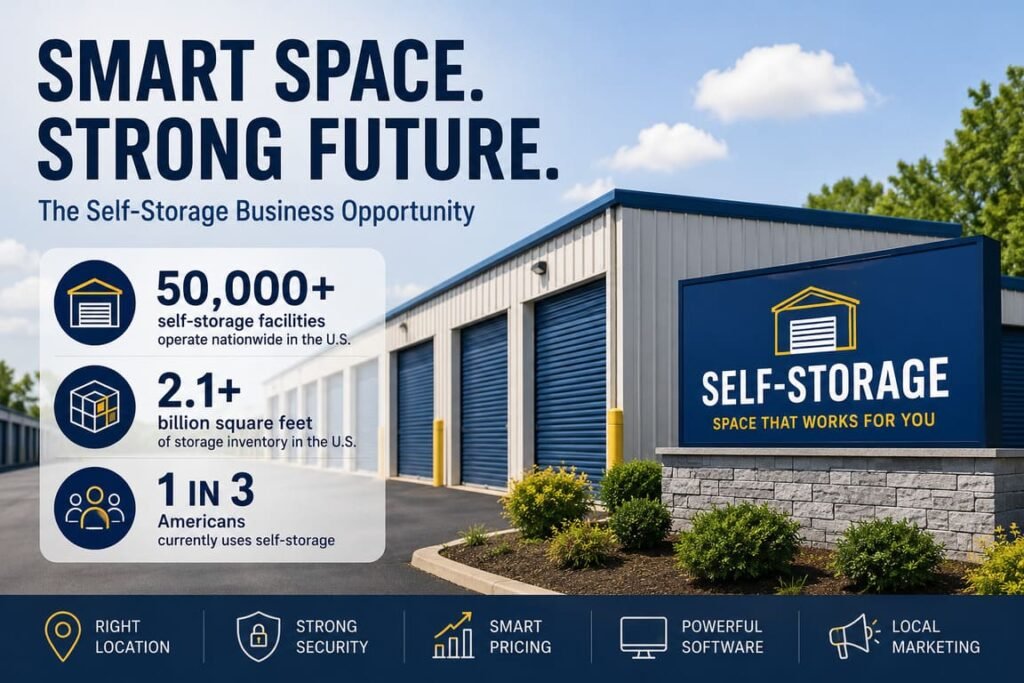
Starting a storage unit business can be a smart long-term play if you choose the right market and keep your numbers under control. The self-storage industry in the U.S. remains large and active: Inside Self-Storage says the industry generates an estimated $44 billion annually, while SpareFoot reports there are more than 50,000 self-storage facilities nationwide and over 2.1 billion square feet of storage space in the U.S.
The business looks simple from the outside, but good operators win because they are disciplined about location, zoning, financing, security, pricing, software, and local marketing. If you want to do this professionally, do not start with construction plans. Start with market proof. That is also the approach recommended by the U.S. Small Business Administration (SBA), which says market research and competitive analysis should come first.
Why this business attracts investors
A storage unit business can be appealing because it usually needs less staff than many other real estate businesses, and it can create recurring monthly income. But it is not “easy money.” A bad site, weak demand, poor access, or overbuilding in the area can hurt the project for years. Inside Self-Storage notes that success depends heavily on location, financing, design, approvals, and launch preparation.
Key industry statistics you should know
- More than 50,000 self-storage facilities operate nationwide in the U.S.
- The U.S. has over 2.1 billion square feet of storage inventory.
- One in three Americans currently uses self-storage, according to SpareFoot.
- Average national occupancy at stabilized facilities was 77.0% in Q4 2025.
- SBDCNet says the largest customer segment is households (69.9%), followed by businesses (18.4%), military (5.9%), and college students (5.8%).
- The Self Storage Association primer says well-designed, well-located facilities can reach 70% to 95% occupancy, but stabilization may take 18 to 36 months or more. Source
These numbers matter for one reason: they tell you this is a real market, but also a competitive one. You need a plan that is local, not generic.
Step 1: Study the market before you spend money
The SBA says solid market research should answer six basic questions: demand, market size, economic indicators, location, market saturation, and pricing. For a storage business, that means you should look at:
- Population in the trade area
- Household income
- Apartment density and small-home density
- Local business activity
- Competitor count
- Competitor pricing
- Occupancy estimates
- Planned new storage projects
- Traffic counts and visibility
- Ease of access for moving trucks
The Self Storage Association recommends studying a 1-mile, 3-mile, and 5-mile radius around the proposed site. It also says to map current and future competitors and watch for danger signs of overbuilding, such as higher vacancy, shorter tenant stays, longer lease-up periods, and heavy move-in discounting.
What to check in your local market
- Are nearby facilities full or discounting hard?
- Is population growing?
- Are there many renters, students, military families, or small businesses nearby?
- Is there new apartment construction?
- Can people easily see and enter your site?
- Is there room for climate-controlled units?
- Is a competitor opening soon?
If you skip this step, you are guessing.
Step 2: Choose the right location
In storage, location is not just “nice to have.” It is the deal.
Inside Self-Storage says most renters prefer a facility within three to five miles of home or work. It also recommends high visibility, easy access, and strong traffic counts. A useful benchmark from the guide is at least 15,000 vehicles per day, with 25,000+ considered ideal.
The Self Storage Association primer highlights these site factors:
- Street visibility
- Easy access
- Customer density within a 3–5 mile radius
- Growth trends
- Current saturation
- Land cost
- Zoning fit
- Commuter traffic patterns
A cheap parcel in the wrong spot is usually more expensive in the long run than a better site with stronger demand.
Step 3: Decide whether to buy an existing facility or build a new one
This is one of the biggest early decisions.
Storable says new owners should compare buying an existing facility with building from the ground up. Buying gives you existing revenue, operating history, and known demand. Building gives you more control over layout, security, unit mix, and modern features.
Here is a simple comparison:
| Option | Main advantage | Main downside | Best for |
|---|---|---|---|
| Buy existing facility | Existing cash flow and customer base | Higher purchase price, possible operational problems | Investors who want faster entry |
| Build new facility | Full control over design, technology, and unit mix | More time, permits, construction risk, lease-up risk | Operators with patience and development skills |
| Convert existing building | Can be faster than ground-up in some markets | Layout limitations and retrofit costs | Markets with suitable vacant buildings |
A beginner often underestimates how much time zoning, approvals, and lease-up can take. If speed and predictability matter most, buying can be safer. If the market has a clear supply gap, building may offer better upside.
Step 4: Write a real business plan
The SBA says a business plan should cover these core sections:
- Executive summary
- Company description
- Market analysis
- Organization and management
- Service or product line
- Marketing and sales
- Funding request
- Financial projections
- Appendix
For a storage unit business, your plan should clearly explain:
- Your target customers
- Your trade area
- Your competitor list
- Your pricing strategy
- Your unit mix
- Your financing structure
- Your staffing plan
- Your lease-up timeline
- Your break-even point
- Your risk controls
This is not just for lenders. It is for you. A weak plan usually means weak decisions later.
Step 5: Understand the startup costs
Your costs depend on whether you buy, build, or convert. But you should at least model these categories:
- Land or acquisition cost
- Due diligence
- Legal and accounting
- Survey, engineering, and architecture
- Permits and impact fees
- Construction
- Gates, fencing, and access control
- Cameras and security
- Signage
- Website and software
- Insurance
- Payroll
- Utilities
- Marketing
- Working capital for lease-up
The Self Storage Association primer says land cost is often about 25% to 30% of total development cost. It also says average operating costs are roughly 25% to 40% of actual stabilized income, while break-even operating expenses can be 40% to 60% of total stabilized income excluding debt service.
Inside Self-Storage says recent construction estimates ranged from about $80 to $100 per square foot for large single-phase, single-story facilities.
That does not mean your project will cost exactly that. It means you should not start with rough guesses. Build a full cost model.
Step 6: Secure financing
Inside Self-Storage says common funding paths include traditional bank loans and SBA loans, especially 504 or 7(a) structures. The article notes that bank loans often require a 30% to 50% down payment, while SBA loans may require less cash down and can help cover carrying costs during the early breakeven period.
Storable also points to equity partnerships, joint ventures, and syndicates as possible funding options depending on the project.
Before talking to lenders, prepare:
- Business plan
- Market study or feasibility study
- Personal financial statement
- Project budget
- Construction timeline
- Lease-up assumptions
- Exit strategy
- Resume or track record of the team
Lenders like storage, but they still want proof.
Step 7: Get zoning and approvals right
A great market can still fail as a project if zoning is wrong.
Inside Self-Storage stresses that zoning should be checked early, ideally before you get deep into design costs. If rezoning is needed, approvals may take three to six months in simpler cases and a year or more in harder ones.
You also need to think about:
- Site plan approval
- Building permits
- Drainage and stormwater
- Fire safety
- ADA compliance
- Access and traffic issues
- Landscaping and appearance requirements
Do not buy land assuming approvals will be easy.
Step 8: Build the right unit mix and features
A good facility is not just a row of boxes. It should match local demand.
Your unit mix may include:
- Small units for personal storage
- Mid-size units for apartment moves
- Large units for household goods or business inventory
- Climate-controlled units
- Drive-up units
- Vehicle, RV, or boat storage
- Packing supply sales
Because households are the largest customer segment, most facilities need a strong base of personal-storage units. But in some markets, businesses, students, or military demand can change the mix.
Step 9: Set up operations and technology from day one
Storable strongly recommends using modern self-storage software to automate:
- Billing and payments
- Online move-ins
- Tenant communication
- Reporting
- Marketing
- Unit management
This matters because today’s customers expect convenience. Your website should make it easy to:
- See unit sizes
- Check availability
- Reserve online
- Pay online
- Sign documents
- Contact the facility
If your local competitors still rely on phone-only leasing, better technology can become a real edge.
Step 10: Market the facility before you open
Inside Self-Storage says launch preparation should begin three to six months before opening. It recommends:
- Operations manual
- Staff hiring and training
- Website setup
- Local SEO
- Social profiles
- Relationships with local businesses and real estate groups
- Move-in specials
- Referral discounts
Good low-cost marketing ideas include:
- Google Business Profile
- Local SEO pages for nearby neighborhoods
- Move-in promotions
- Realtor and apartment manager referrals
- Truck rental and moving company relationships
- Business inventory storage offers
- Student storage promotions
- Military storage promotions where relevant
Marketing is not optional. A new facility without a demand engine can sit half-empty for too long.
A practical startup checklist
Use this simple checklist:
- Pick your target market and trade area
- Study a 1-, 3-, and 5-mile radius
- Count competitors and compare prices
- Estimate demand and lease-up speed
- Decide whether to buy, build, or convert
- Build a full financial model
- Confirm zoning and site access
- Secure financing
- Finalize design, security, and unit mix
- Set up software, website, and payments
- Start marketing before opening
- Track occupancy, inquiries, move-ins, and churn every month
Common mistakes to avoid
- Building in an over-supplied market
- Ignoring visibility and access
- Underestimating approvals and delays
- Using weak lease-up assumptions
- Spending too little on marketing
- Delaying software and online rentals
- Setting prices without checking local competitors
- Forgetting climate-controlled demand where it matters
- Running without clear operating procedures
The Self Storage Association specifically warns new operators to watch for signs of overbuilding, such as increased vacancy and aggressive move-in discounts in the market.
Best professional guides to use
If you want practical, professional guidance, start with these:
- SBA market research guide for how to study demand, pricing, saturation, and local economic indicators
- SBA business plan guide for building your lender-ready plan
- Storable startup guide for planning, technology, and operating systems
- Inside Self-Storage development guide for site selection, financing, approvals, and launch
- SBDCNet self-storage snapshot for customer segments, associations, and planning links
- Self Storage Association primer for feasibility rules of thumb, occupancy ranges, and
Final takeaway
A storage unit business can work very well, but only if you treat it like a numbers-and-execution business. Start with local market proof. Pick a visible, accessible site. Know your costs. Use modern software. Begin marketing before opening. And never assume demand just because storage looks popular nationally. National trends help, but local supply and local pricing decide whether your project wins.
FAQ
Is a storage unit business profitable?
It can be profitable, but profitability depends on location, demand, occupancy, pricing, debt load, and operating discipline. The industry is large and active, but not every market is a good market.
How much money do I need to start?
There is no single number. It depends on whether you buy, build, or convert. You need to budget for land or acquisition, approvals, construction or renovation, security, software, insurance, marketing, and working capital.
Should I buy an existing facility or build a new one?
Buying is often faster and gives you existing income. Building gives you more control and modern features but adds more risk, more time, and more approvals.
How long does it take to reach stable occupancy?
The Self Storage Association primer says stabilization can take 18 to 36 months or more.
What customers usually rent storage units?
Households are the largest segment, followed by businesses, military customers, and college students.
Do I really need software for a small facility?
Yes. Modern software helps with payments, online rentals, communication, reporting, and day-to-day management. It saves time and improves the customer experience.
What is the biggest mistake beginners make?
A common mistake is building or buying in an over-supplied market without doing real feasibility work first.