

Which AI Tool Is Best for Content Writing?
For most individuals and small teams, ChatGPT is the best all-around AI tool for content writing because it combines research support, flexible drafting, file-based context, iterative editing, and a dedicated Canvas workspace. It is not the automatic winner for every job. Claude is often a stronger fit for long-form prose and voice-sensitive revision, Jasper suits teams that need brand controls, Writesonic and Surfer focus more heavily on SEO workflows, and Grammarly is most useful at the final editing stage.
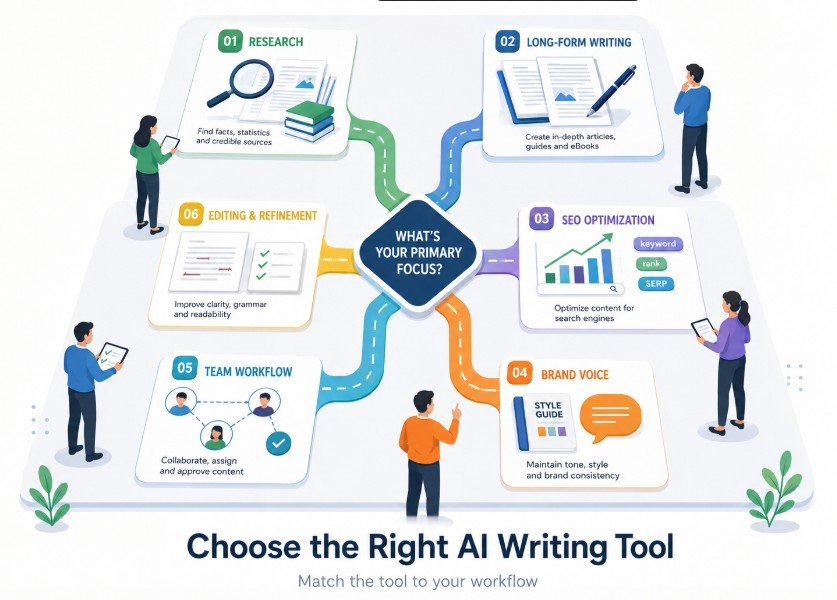
That distinction matters. Choosing an AI tool for content writing by asking which one produces the most impressive paragraph usually leads to the wrong purchase. A useful tool must solve the slowest or most error-prone part of your process. For one writer, that is research. For another, it is turning interviews into a coherent article. A marketing team may care more about approvals, terminology, and brand consistency than first-draft elegance.
This comparison evaluates tools by job fit rather than promotional feature count. Product capabilities are based on official information available in July 2026. Editorial recommendations are judgments, not vendor rankings.
Best AI Tool for Content Writing by Use Case
| Tool | Best use case | Main strength | Main limitation |
|---|---|---|---|
| ChatGPT | Best overall for most users | Flexible research, drafting, revision, and project context | Quality depends heavily on instructions and source control |
| Claude | Long-form articles and voice-sensitive editing | Handles substantial context and can adapt to supplied writing styles | Less specialized SEO guidance than dedicated platforms |
| Gemini | Research tied to Google Workspace | Works naturally with Docs and Drive-based material | A strong research report still needs editorial restructuring |
| Jasper | Multi-writer marketing teams | Brand Voice, style rules, audience settings, and company knowledge | More system than many solo writers need |
| Writesonic | SEO article production | Research, keyword work, drafting, citations, and optimization in one pipeline | Automation can encourage publishing before enough human revision |
| Surfer | SEO briefs and content optimization | Data-led guidance for outlines, topical coverage, and existing pages | A high content score does not guarantee useful or original writing |
| Copy.ai | Repeatable marketing operations | Brand-aware agents and automated content workflows | Best value appears when processes are already documented |
| Grammarly | Final editing across apps | Proofreading, clarity, tone, and sentence-level rewriting | Not the strongest primary research or long-form planning tool |
ChatGPT supports ongoing writing projects and a Canvas interface where users can edit directly, select passages, request targeted changes, adjust length, and review earlier versions. Claude Projects can use uploaded documents as a knowledge base, while custom Styles can be created from writing samples. These features explain why both tools work well when the task requires multiple revision rounds rather than one prompt and one draft.
Jasper places more emphasis on organizational control through Brand Voice, audiences, style guidance, and a knowledge base. Writesonic presents its article writer as a multi-step pipeline that includes research, SEO work, source support, and review. Surfer’s Content Editor supplies data-informed writing guidance and can generate an outline or article through Surfer AI. Copy.ai focuses on agents, reusable workflows, company information, and brand voice. Grammarly concentrates on drafting assistance, rewriting, tone, clarity, and proofreading across many applications.
How to Choose an AI Tool for Content Writing
An AI tool for content writing can look excellent in a demo and still create more work in a real editorial process. The better test is whether its output survives fact-checking, restructuring, brand review, and subject-matter scrutiny. When choosing an AI tool for content writing, judge the complete path to publication rather than the first draft.
Use six criteria when comparing content writing software:
- Source discipline: Can the tool work from documents you provide, distinguish evidence from inference, and show where claims came from?
- Structural control: Can you change the argument, section order, depth, and reader level without rebuilding the entire draft?
- Voice retention: Does revision preserve the author’s position and phrasing, or replace it with generic marketing language?
- Editorial visibility: Can a human review changes, compare versions, and correct a specific passage?
- Workflow fit: Does the tool connect with the documents, content briefs, approval steps, and publishing systems already in use?
- Risk management: Can your team prevent unsupported claims, confidential uploads, accidental plagiarism, and mass production of weak pages?
A useful evaluation gives more weight to the expensive mistakes. A bland sentence takes one minute to rewrite. A fabricated product specification, legal claim, medical statement, or quotation can damage trust and require a full correction process.
Search optimization cannot rescue an article that is inaccurate, derivative, or unhelpful. According to Google’s official guidance on generative AI content, AI can assist with research and content structure, but publishing large numbers of pages without meaningful value may violate Google’s spam policies.
A Practical Scoring Model
| Criterion | Suggested weight | What to test |
|---|---|---|
| Factual reliability and traceability | 25% | Verify every factual claim against supplied or primary sources |
| Editorial control | 20% | Request structural changes without losing important details |
| Writing quality | 20% | Check specificity, rhythm, clarity, and repetition |
| Brand and audience fit | 15% | Compare the draft with an approved style guide and examples |
| SEO support | 10% | Review intent coverage, headings, entities, internal links, and metadata |
| Workflow efficiency | 10% | Measure setup time, editing time, exports, and collaboration |
This weighting deliberately gives SEO a smaller share than factual and editorial quality. Search optimization cannot rescue an article that is inaccurate, derivative, or unhelpful. Google’s current guidance says generative AI can help with research and structure, but producing many pages without added value may violate its scaled content abuse policy. Google continues to emphasize accuracy, relevance, originality, and people-first usefulness rather than the mere presence or absence of AI.
Detailed Comparison: Finding the Right AI Tool for Content Writing
ChatGPT Is the Strongest General-Purpose Choice
ChatGPT is the safest default when one subscription must cover research, outlining, drafting, rewriting, and repurposing. Projects retain context for repeated work, while Canvas supports direct editing and focused revisions. As an AI tool for content writing, it gives editors more structural freedom than a guided SEO platform.
Its flexibility requires discipline. Vague prompts produce plausible but unfocused copy, so instructions should define acceptable sources, publication dates, audience knowledge, prohibited claims, and how uncertainty must be marked. Treat ChatGPT as an editorial collaborator with a strict brief, not an unattended publishing system.
Claude Fits Long Documents and Sensitive Voice Work
Claude is a strong option when the source pack is large or the writer wants to preserve a distinct tone. Projects can use uploaded style guides, transcripts, and previous work, while custom Styles can be based on writing samples or manual instructions.
This setup suits reports, thought leadership, and interview-led articles. Claude can identify missing reasoning, compress repetition, and test whether claims follow from the evidence. It is not a full SEO suite, so keyword analysis and content scoring may require another tool. For writers who already have a strong brief, that cleaner focus can be useful.
Gemini Makes Sense Inside Google-Based Workflows
Gemini is attractive when briefs, sources, and drafts already live in Google Drive and Docs. Google positions Gemini in Docs as a writing partner and has expanded Drive search, synthesis, and Deep Research features.
The integration reduces copying between tools, which can matter more than a small difference in paragraph quality. Still, a research report is not a finished article. An editor must reorganize material around the reader’s decision, qualify uncertain claims, and remove details that do not support the page.
Jasper Is Built for Brand Governance at Scale
Jasper is better understood as a marketing content system than a simple chatbot. It combines brand voice, audience definitions, style rules, and company knowledge, which helps when several employees or contractors write for one brand.
A solo writer may not need that layer. Multi-brand companies and agencies can use it to control required terms, restricted phrases, audience differences, and approved facts. The setup still matters: an AI tool for content writing cannot repair vague positioning or weak source material.
Writesonic Targets an End-to-End SEO Article Pipeline
Writesonic is designed for users who want research, keyword work, source support, outlining, writing, and review inside one SEO pipeline. That can reduce setup time for agencies and site owners producing search-led articles.
The trade-off is editorial sameness. Guided pipelines make default decisions about section order, competitor coverage, and optimization. A human editor should replace borrowed framing, add first-hand detail, remove weak claims, and decide which competitor topics are irrelevant.
Surfer Is Most Useful Before and After the First Draft
Surfer is most useful for building a brief and diagnosing gaps after a draft exists. Its Content Editor provides topic-based guidance, supports outlines, and can optimize new or existing pages. Surfer AI can also generate content.
A content score is a diagnostic signal, not a quality certificate. Adding every suggested term can reduce readability or distort intent. Use recommendations to investigate missing coverage, then accept only those that improve the page.
Copy.ai Is Suited to Repeatable Content Operations
Copy.ai emphasizes content agents, workflows, an Infobase, and Brand Voice. It fits repeated sequences such as turning a webinar into a blog post, social posts, an email, and sales material.
Its value is consistency across outputs, not necessarily the best single draft. A documented process can use approved information and send channel-specific content through review. Without a stable process, automation repeats unclear decisions faster.
Grammarly Is the Strongest Companion Editor
Grammarly is most valuable after the writer has something worth editing. It provides proofreading, tone guidance, clarity suggestions, paragraph rewriting, and generative support across many apps and websites.
It can draft, but its clearest role is sentence-level quality control. Use it to catch awkward phrasing, unnecessary complexity, tone mismatches, and grammar problems. It does not replace source research or a strong argument.
Comparison: Which AI Tool for Content Writing Should You Choose?
| Situation | Recommended choice | Why |
|---|---|---|
| You want one tool for many content formats | ChatGPT | Broadest balance of research, drafting, revision, and project work |
| You publish detailed long-form articles | Claude | Strong fit for large source packs and voice-aware editing |
| Your files and drafts live in Google Workspace | Gemini | Lower friction with Docs and Drive material |
| Many people must follow one brand system | Jasper | Strong controls for voice, audience, style, and approved knowledge |
| You need SEO articles from keyword to draft | Writesonic | Guided research and production pipeline |
| You already write well but need SEO guidance | Surfer | Useful briefs, coverage analysis, and optimization |
| You repurpose the same source into many assets | Copy.ai | Workflow automation and reusable brand context |
| Your main problem is final-language quality | Grammarly | Strong editing layer across existing work tools |
A sensible stack is often two tools: one for research and drafting, another for optimization or language. More subscriptions do not improve a page when no one owns the brief, evidence, and final edit. This is a better buying rule than searching for one universal AI tool for content writing.
In this Reddit discussion about AI writing tools, writers compare Claude, ChatGPT, and specialized platforms for long-form content, editing, and creative work. Such discussions should be treated as user opinion rather than objective evidence, but they can reveal practical limitations that product pages rarely mention.
How to Test an AI Tool for Content Writing Before Subscribing
Do not compare an AI tool for content writing with random prompts. Run the same real assignment through each candidate.
- Choose one representative brief. Use a topic you genuinely plan to publish, with a clear audience, objective, word range, and conversion action.
- Prepare a fixed source pack. Include primary sources, internal documents, product facts, interview notes, and an approved style sample.
- Write one master instruction. Define the search intent, required sections, prohibited claims, citation rules, tone, and what the tool should do when evidence is missing.
- Generate only an outline first. Check whether the structure answers the reader’s question or merely copies familiar listicle patterns.
- Draft two difficult sections. Pick the opening and the most technical or commercially sensitive section. These reveal more than a full easy draft.
- Request a major revision. Change the audience, remove one argument, add a constraint, and ask the tool to preserve verified facts.
- Measure edit burden. Record the time spent checking sources, removing repetition, repairing structure, and restoring brand voice.
- Review total workflow cost. Include setup, training, approvals, exports, and additional tools, not only the subscription price.
The winner is the tool that produces the lowest reliable publication cost. That may be different from the tool that creates the smoothest first draft.
Composite Examples: Matching the Tool to the Workflow
The following scenarios combine common content situations. They are hypothetical and are not presented as customer case studies.
Scenario 1: A Solo Consultant Publishing Two Expert Articles per Month
The consultant has interview notes, client questions, and trusted industry sources. ChatGPT or Claude can organize evidence, build a non-standard outline, draft sections, and challenge unsupported claims. A lightweight SEO checker may be added at the end. A full automation platform would add setup without solving the main constraint, which is expert time.
Scenario 2: An Ecommerce Team Updating 300 Category Descriptions
Here the challenge is consistency, product accuracy, and controlled scale. Jasper or Copy.ai may fit better than an open-ended chat. Before generation, the team needs approved product data, restricted-claim rules, terminology, audience segments, and sample descriptions. Someone must still audit batches for incorrect specifications, duplicated wording, exaggerated claims, and mismatched intent.
Scenario 3: An SEO Agency Refreshing Declining Blog Posts
Surfer can identify topical gaps, while ChatGPT or Claude can restructure weak sections and integrate new sources. Writesonic may suit an agency that wants a unified keyword-to-article process. The team should still ask why the old page no longer satisfies readers. The fix may be a clearer answer, updated screenshots, first-hand testing, a calculator, or removal of obsolete advice rather than more text.
A Practical Prompt for Evaluating an AI Tool for Content Writing
Use a prompt that exposes weaknesses instead of inviting generic prose:
Act as a content editor, not an automatic publisher. Create an outline for an informational article aimed at [audience] who need to [specific task]. Use only the supplied sources for factual claims. Mark any unsupported statement as “verification needed.” Prioritize the reader’s decision process rather than competitor heading patterns. Include one practical example, one limitation section, and a checklist. Avoid repeating the same idea under different headings. Before drafting, identify the three most important editorial decisions and explain why they matter.
After the outline is approved, provide one section at a time. This makes factual errors, structural drift, and repetitive writing easier to catch than requesting 3,000 words in a single response.
Risks That Matter More Than AI Detection Scores
Unsupported Facts Can Sound Finished
Fluent language creates false confidence. Verify names, dates, product features, numerical claims, legal requirements, quotations, and source interpretations. For high-risk subjects, use qualified human review.
SEO Automation Can Copy the Market’s Weaknesses
Competitor analysis is useful for discovering reader questions and missing entities. It becomes harmful when the tool reproduces the same heading sequence, examples, and shallow definitions found across the ranking pages. Originality comes from new evidence, clearer judgment, direct experience, or a better way of solving the reader’s problem.
AI Detector Results Are Not a Publishing Standard
Do not rewrite accurate, readable copy simply to obtain a lower AI-detection score. Detector results are estimates and should not be treated as proof of authorship. The Federal Trade Commission’s final action against Workado followed allegations that the company promoted unsupported accuracy claims for its AI-content detector. Detection scores may be used as one internal review signal, but they cannot replace source verification, plagiarism checks, or human editorial judgment.
Brand Voice Is Not a Tone Label
“Friendly and professional” is too vague to guide a serious AI content writer. A usable voice system includes sentence patterns, level of directness, terminology, preferred evidence, forbidden claims, formatting choices, and examples of what the brand would not publish.
Automation Can Hide Editorial Ownership
Every page needs a responsible person. That person decides which sources are acceptable, resolves contradictions, approves claims, and confirms that the final page serves the reader rather than a production quota.
Publication Checklist for AI-Assisted Content
Before publishing, confirm the following:
- The opening answers the main query without a long general introduction.
- Each factual claim is supported by a current, appropriate source.
- Product details and pricing were checked on the publication date.
- The article adds analysis, experience, examples, or tools not found in a basic competitor summary.
- Search intent is satisfied without repeating the same keyword mechanically.
- Headings describe specific reader questions or decisions.
- Examples are labeled as real, composite, or hypothetical.
- AI-generated citations and quotations were opened and verified.
- Repetition, generic transitions, and empty claims were removed.
- The brand’s approved terminology and restricted claims were checked.
- A human editor reviewed the final structure, not only grammar.
- Metadata describes the actual page rather than promising results it cannot deliver.
- The final page provides a clear next step.
Frequently Asked Questions
What Is the Best AI Tool for Content Writing Overall?
ChatGPT is the best general-purpose choice for most users because it can support research, planning, drafting, direct editing, and repeated project work in one environment. Claude may be better when long source documents and writing style are the main priorities. The correct choice depends on the stage that consumes the most editorial time.
Which AI Tool for Content Writing Is Best for SEO?
Writesonic is a strong option for an integrated SEO article pipeline, while Surfer is particularly useful for briefs, topical coverage, and optimization of drafts or existing pages. Teams that want more structural freedom can combine ChatGPT or Claude with a dedicated SEO platform.
What Is the Best Free AI Tool for Content Writing?
Free plans change frequently, so compare current limits before deciding. Beginners usually gain more from a general assistant that supports outlines, short drafts, rewriting, and prompt practice than from a narrow platform. Test free access with a real brief, not by the advertised word allowance.
Can an AI Content Writer Replace a Human Writer?
It can replace parts of the process, especially idea expansion, summarization, first drafts, formatting, and repetitive variations. It cannot take responsibility for evidence, original experience, commercial claims, audience judgment, or final publication. Professional writers remain necessary where accuracy, differentiation, and trust affect the outcome.
Research with professional writers has identified persistent challenges around preserving style and authorial voice. A separate writing-quality benchmark found that strong general models were not automatically reliable judges of good writing, supporting human editorial review as the final standard.
Does Google Penalize AI-Written Content?
Google says it evaluates content quality and usefulness rather than banning content simply because AI was involved. However, generating many pages primarily to manipulate rankings, without original value for users, can violate its spam policies. Accuracy, relevance, originality, and people-first purpose remain the safer standard.
Which Tool Is Best for Maintaining Brand Voice?
Jasper is a strong dedicated choice for organizations because it combines Brand Voice with audiences, style rules, and company knowledge. Claude and Copy.ai also support custom style or brand context. The quality of any system depends on the examples and rules supplied to it.
Is One AI Tool Enough for Professional Content Creation?
Often, yes. A general assistant plus a disciplined human workflow can cover research, outlines, drafting, and revision. Add a second product only when it solves a measurable gap such as SEO analysis, organization-wide brand control, workflow automation, or cross-application proofreading.
How Should a Business Calculate the Value of an AI Writing Tool?
Track the full time from brief to approved publication. Include research, prompt preparation, fact-checking, rewriting, stakeholder review, and corrections. Compare that total with your previous process. Faster generation has little value when review time or publication risk increases.
The Practical Recommendation
Choose ChatGPT when you need the best all-around AI tool for content writing. Choose Claude when long-form quality and source-heavy editing matter most. Select Gemini for a Google Workspace-centered process, Jasper for brand governance, Writesonic for a guided SEO production pipeline, Surfer for optimization, Copy.ai for repeatable content operations, and Grammarly for final-language polish.
The purchase decision should follow a controlled test with your own brief, sources, and approval standards. The best AI writing tool is the one that reduces reliable editing time while keeping a human accountable for the published page.