
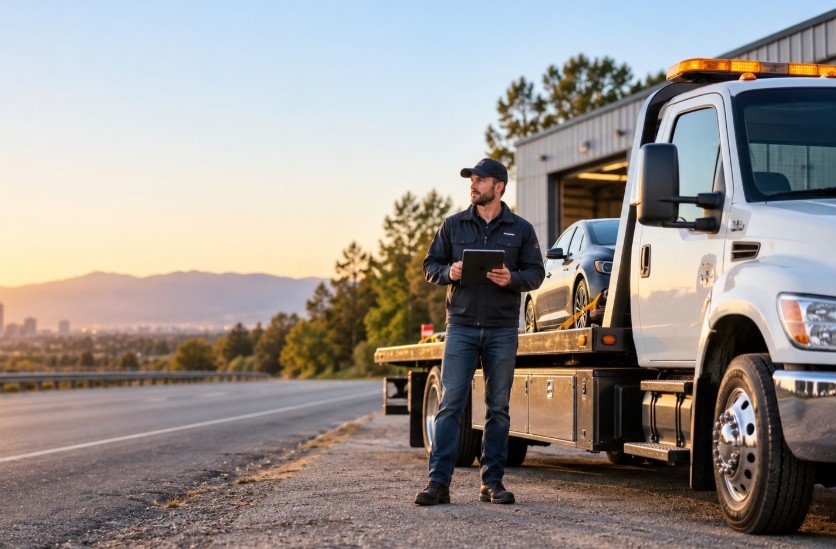
How to start a tow truck business in 2026
If you want to know how to start a tow truck business, shopping for a truck should not be your first move. Start by deciding what kind of jobs you want to take, where you plan to operate, and where those jobs will come from. A company focused on roadside assistance may have very different equipment, insurance, storage, licensing, and operating needs from a private-property towing company or a police-rotation contractor.
A safer sequence is to choose the business model, check federal and local requirements, get insurance quotes, work out your break-even point, and then commit to a truck.
This guide covers how to start a towing business in the United States. Rules vary by state, county, and city, especially when non-consensual towing and vehicle storage are involved.
How to start a tow truck business: 10 steps
A basic launch sequence looks like this:
- Decide which towing and roadside services you will offer.
- Choose your service area and research local demand.
- Check state, city, county, and federal requirements.
- Prepare a tow truck business plan and startup budget.
- Register the company and obtain the necessary tax IDs.
- Get commercial insurance quotes before buying equipment.
- Choose a tow truck that fits the jobs you plan to take.
- Set up pricing, dispatch, payment, and documentation procedures.
- Develop referral channels and local search visibility.
- Test the operation before taking your first paid tow.
Following this order can save you from an expensive mistake. If you buy a $70,000 truck before researching permits, you may discover too late that the vehicle, storage setup, insurance, or licensing does not meet local requirements.
Start with the jobs, not the truck
“Towing company” can describe several different businesses, and their economics are not the same.
| Business model | Typical jobs | Main advantage | Main limitation |
|---|---|---|---|
| Roadside assistance | Jump-starts, tire changes, lockouts, fuel delivery | Many calls require less equipment | Many jobs bring in less revenue than a full tow |
| Consensual towing | Breakdowns, accident towing, repair-shop transport | Straightforward customer relationship | Call volume can be inconsistent |
| Private-property towing | Unauthorized parking and property-management accounts | Recurring commercial relationships are possible | Local non-consent towing rules can be strict |
| Police rotation | Crashes, breakdowns, abandoned vehicles | Can provide recurring dispatch volume | Approval, equipment, response-time, yard, or experience requirements may apply |
| Vehicle transport | Dealer transfers, auction vehicles, scheduled moves | Scheduling can be more predictable | Competes with auto-transport providers as well as local towing companies |
| Heavy recovery | Trucks, buses, commercial vehicles, difficult recoveries | Higher-value jobs are possible | Requires much more equipment, training, insurance, and capital |
For many first-time operators, light-duty consensual towing is easier to evaluate than immediately trying to build a heavy-recovery operation.
Before buying equipment, ask yourself:
What work can I realistically win during my first six months, and what equipment will I need to do it?
A flatbed may be a good fit if you plan to work with repair shops, dealerships, auctions, AWD vehicles, accident-damaged cars, and scheduled transport. A wheel-lift truck may suit a business doing a different mix of shorter local jobs. Heavy-duty equipment is difficult to justify if you have no realistic source of heavy-recovery calls.
Research five to ten local competitors before settling on a business model. Look at their service areas, reviews, hours, commercial accounts, and service mix. TechStarts’ guide to competitive analysis AI prompts can help organize that research instead of leaving you with a simple list of competitor names.
How much does it cost to start a tow truck business?
There is no reliable single startup figure.
Current guides in the search results give estimates ranging from tens of thousands of dollars for a financed single-truck business to well above $100,000 when the truck is purchased outright. Much of that difference comes down to what each estimate includes.
A useful tow truck business startup cost calculation separates three figures:
- Asset cost: the value of the truck and equipment.
- Cash required to open: deposits, down payments, registrations, permits, equipment, marketing, and initial working capital.
- First-year operating requirement: truck payments, insurance, fuel, repairs, payroll, storage, software, taxes, and other ongoing expenses.
Combining all three into one number can make startup estimates misleading.
A practical startup budget
Treat this as a budgeting framework, not a price list.
| Expense | How to estimate it |
|---|---|
| Tow truck | Get prices for at least 5 comparable trucks with the correct GVWR and equipment |
| Initial repairs and inspection | Have a commercial mechanic inspect a used truck before purchase |
| Commercial auto insurance | Get quotes using the exact truck VIN or vehicle specifications |
| On-hook coverage | Request a quote based on the value of the customer vehicles you expect to tow |
| Garagekeepers coverage | Check whether you will store or control customer vehicles |
| Business registration | Verify fees with your state |
| Towing permits/licenses | Check state, county, and city requirements |
| Federal registration | Determine whether USDOT registration or operating authority applies |
| Storage lot | Include rent, deposit, fencing, lighting, security, zoning, and signage when required |
| Towing equipment | Straps, chains, dollies, skates, lights, cones, PPE, lockout gear, jump equipment |
| Dispatch and phone | Price software, business phone service, GPS, invoicing, and payment processing |
| Website and marketing | Domain, website, local SEO, signs, printed materials, and initial advertising |
| Working capital | Keep cash available for fuel, repairs, insurance, and other bills before receivables are collected |
Truck prices alone show why broad startup estimates can be misleading. Current TruckPaper listings reviewed in September 2026 include older rollback trucks in roughly the $20,000 to $40,000 range, while late-model and new units can exceed $100,000. Heavy wreckers can cost several times more. Mileage, truck class, body, equipment, condition, and location can change the price significantly.
Financing does not turn a $70,000 truck into a $15,000 truck. It can reduce the amount of cash you need upfront, but the remaining debt becomes part of your monthly overhead.
Build your tow truck business plan around break-even calls
A towing business plan is more useful when it tells you how many paid jobs you need each month.
Start with this formula:
Monthly fixed costs ÷ average contribution per completed job = approximate break-even job volume
Contribution is the amount left from each job after paying the expenses directly associated with completing it.
Consider this purely hypothetical example:
- Monthly fixed expenses: $7,500
- Average customer payment per completed job: $225
- Fuel, payment-processing, and other variable expenses per job: $75
- Contribution per job: $150
The business would need about:
$7,500 ÷ $150 = 50 completed jobs per month
That works out to roughly 12 to 13 jobs per week before the business begins producing operating profit.
This is only an example, not an industry benchmark. It shows why average revenue by itself says very little about profitability.
Run the calculation separately for direct customer towing, roadside calls, motor-club work, commercial accounts, and storage revenue. A channel can generate plenty of calls and still perform poorly if the payment per job is too low or the truck spends too much time driving empty.
The U.S. Small Business Administration recommends separating one-time expenses from monthly startup expenses and using break-even analysis before seeking funding.
Check licenses and registrations before buying equipment
The exact towing business license requirements depend heavily on where you operate and what type of towing you plan to do.
There are four main areas to investigate.
Business registration
Choose a legal structure, register the company where required, and keep business finances separate from personal finances.
Many towing companies use an LLC or corporation, but the right structure depends on taxes, ownership, liability considerations, and state law.
You can obtain an Employer Identification Number directly from the IRS at no charge. An EIN may be required depending on the business structure and its activities. Banks and licensing agencies may also ask for one.
State and local towing rules
Search specifically for:
- tow company license
- tow truck permit
- driver permit
- non-consent towing license
- storage or impound license
- local rate limits
- required towing receipts
- signage rules
- vehicle-release procedures
- notification requirements
- lien procedures
- storage-lot zoning
A general city business license does not necessarily allow you to perform every type of towing.
Private-property and non-consensual towing require extra attention because local governments may regulate fees, notices, signage, storage, release procedures, and agreements with property owners.
Do you need a USDOT number?
A USDOT number is not a universal tow-truck license.
FMCSA generally requires a USDOT number for vehicles used in interstate commerce when the vehicle or combination meets certain criteria. Those criteria include a GVWR, GCWR, GVW, or GCW of 10,001 pounds or more. FMCSA also notes that several states require USDOT numbers for some intrastate commercial carriers.
FMCSA does not charge an application fee for a USDOT number.
Interstate for-hire operations may also require federal operating authority. Whether authority is required depends on what the company transports and how it operates. Use FMCSA’s registration guidance instead of filing automatically for every type of authority. FMCSA currently lists a $300 filing fee for each individual operating authority requested, and that fee is non-refundable.
Do you need a CDL to drive a tow truck?
Not every tow truck requires a CDL.
According to FMCSA’s tow-truck guidance:
- A Class A CDL is required when the tow truck combination has a GCWR of at least 26,001 pounds and the towed vehicle exceeds 10,000 pounds GVWR.
- A Class B CDL applies when the tow truck itself has a GVWR of at least 26,001 pounds and is operated without a tow or with a towed vehicle of 10,000 pounds or less.
- Some other configurations fall outside the federal Class A and Class B CDL thresholds, although state requirements still need to be checked.
FMCSA specifically addresses tow truck operators in its CDL guidance.
This is another reason to check the rules before you buy. GVWR affects more than payload.
Get tow truck insurance quotes before signing for a truck
Treat insurance as part of the buying decision rather than something to arrange after the truck is already yours.
A tow truck insurance package may include several types of coverage, depending on the business:
- commercial auto liability
- physical damage coverage for the tow truck
- on-hook coverage for customer vehicles while they are being towed
- garagekeepers coverage when customer vehicles are stored or otherwise in your care
- general liability
- workers’ compensation when required
- umbrella or excess coverage
- property coverage for a yard or office
Contracts can also affect the limits you need. A repair shop, municipality, motor club, lender, landlord, or police rotation program may require more coverage than the legal minimum.
Before buying a truck, give the insurance broker your actual operating plan, including:
- truck type and GVWR
- estimated annual mileage
- service radius
- expected towing types
- whether you will store vehicles
- driver history
- number of drivers
- interstate or intrastate operation
- commercial contracts you plan to pursue
Get more than one quote.
A truck that looks cheap can become an expensive purchase if its age, configuration, intended use, or driver profile pushes insurance costs beyond what the business can support.
Choosing your first tow truck
Your first truck should be able to handle the work in your business plan without pushing you toward jobs the company is not ready to take.
Used versus new
A used tow truck costs less to buy, but maintenance is less predictable. An independent pre-purchase inspection matters more than how good the truck looks.
Check:
- chassis and frame
- engine condition
- transmission
- hydraulic system
- winch
- wheel lift or rollback bed
- PTO
- cables and controls
- tires
- brakes
- electrical system
- warning lights
- service records
- rust or previous structural repair
- actual rated capacities
A new truck gives you more predictable equipment condition and warranty coverage, but it also requires more capital and can create a larger monthly debt payment if financed.
Mileage should not be your only deciding factor. Tow trucks may spend a lot of time idling and running hydraulic equipment, so service history and overall operating condition matter as well.
Price your towing services based on your costs
Competitor pricing tells you what customers are seeing in the market. It does not tell you what your own company needs to charge.
Work out your rate floor using:
labor + truck cost + fuel + insurance + maintenance + dispatch + payment costs + overhead + target profit
Then compare that figure with local market rates and any government limits that apply.
Your rate card may include:
- base hookup
- loaded mileage
- additional labor
- winching
- roadside service
- after-hours service
- accident recovery
- storage
- administrative charges where legally permitted
Document what each fee covers.
For direct consumer jobs, customers should be able to understand how you calculated the bill. Commercial contracts also need clear payment terms. A $200 job paid immediately and a $200 job paid 45 days later affect the cash position of a new company differently.
Where your first towing customers may come from
Do not base your first year on a single source of calls.
Potential sources include:
- independent repair shops
- body shops
- tire shops
- dealerships
- apartment communities
- commercial property managers
- parking operators
- fleets
- roadside-assistance networks
- motor clubs
- insurance-related dispatch networks
- auctions
- direct Google searches
- local referrals
Each channel works differently.
Motor clubs may help a new towing company generate call volume, but compare their rates and payment terms with your actual cost per call before accepting every job they offer.
Repair shops and body shops can become repeat referral sources when your response times are dependable. Property-management towing can also create recurring work, although it brings more regulatory requirements and a greater chance of conflict with vehicle owners.
Direct local search leads can be attractive because the customer is already looking for help. That makes your Google Business Profile, reviews, website, service pages, phone response, and service-area information commercially important.
When planning your customer acquisition channels, you can also adapt TechStarts’ professional digital marketing prompts to build a local marketing plan around your actual service areas, customer types, and competitors rather than relying on generic promotional ideas.
What to measure from day one
Revenue is only one part of the picture.
Track:
| Metric | What it tells you |
|---|---|
| Calls received | Total demand reaching the business |
| Calls accepted | How much demand you can service |
| Jobs completed | Actual production |
| Revenue per completed job | Average transaction value |
| Variable cost per job | What each job consumes |
| Miles per completed job | Efficiency of the service area |
| Empty miles | Unpaid truck movement |
| Response time | Dispatch performance |
| Cancellation rate | Lost capacity |
| Lead source | Which channels produce calls |
| Payment time | How quickly revenue turns into cash |
| Truck downtime | Lost earning capacity |
| Repair cost per month | Equipment reliability |
Once you have completed 50 to 100 jobs, these numbers will tell you more about your business than an internet article claiming there is a standard tow truck profit margin.
You might find that one service area produces longer trips but better margins, while another generates more calls but too many empty miles. That information should influence where and how you expand.
A 30-day tow truck business launch checklist
Before taking your first paid call, make sure you can answer yes to each of these:
- Business entity and tax setup completed
- Required state and local licenses verified
- USDOT and federal authority requirements checked
- Correct driver license or CDL confirmed
- Insurance bound and certificates available
- Truck registration current
- Truck inspected and mechanically ready
- Tow equipment inspected
- Safety equipment inside the truck
- Pricing documented
- Customer authorization process established
- Towing and condition documentation prepared
- Payment methods working
- Business phone answered reliably
- Dispatch method tested
- Website and Google Business Profile accurate
- Storage arrangements compliant if applicable
- After-hours procedures defined
- Commercial contract requirements checked
- Bookkeeping system ready
- Emergency repair reserve available
Run several test dispatches before opening for paid work. Time the process from receiving the call through locating the customer, assigning the truck, documenting the vehicle, taking payment, and closing the job.
It is much cheaper to find a broken payment link or missing authorization form during a test than when there is a damaged vehicle sitting on the truck bed.
Mistakes that can make a new towing company expensive
Buying equipment before checking the market
Owning a truck does not guarantee enough work. First confirm who can send you enough suitable jobs to keep it moving.
Underestimating working capital
Truck payments, insurance, fuel, repairs, rent, and payroll still have to be paid while you wait for commercial customers to settle their invoices.
Choosing a service area by map radius
Ten miles of open highway is very different from ten miles of dense city traffic. Estimate travel time and empty mileage, not distance alone.
Confusing revenue with profit
A busy day can still lose money if calls are routed poorly, rates are too low, or trucks spend too much time returning empty across the service area.
Relying on one dispatch channel
If losing one motor-club agreement or commercial customer would wipe out most of your call volume, the business is too dependent on that channel.
Treating compliance as a one-time job
Licenses need to be renewed. Driver records change. Insurance policies renew. Trucks need inspections and maintenance. New contracts can bring new requirements.
Put compliance dates on the operating calendar from the beginning.
FAQ
How much money do you need to start a tow truck business?
There is no single amount that applies to every business. The truck is usually the largest asset, but you also need to account for insurance, permits, equipment, storage, marketing, repairs, and working capital. Current tow-truck listings range from older used units costing tens of thousands of dollars to new and heavy-duty equipment priced above $100,000. Calculate both the total value of the assets you need and the cash required to keep the business operating through its first months.
Can you start a tow truck business with no money?
Starting with literally no capital is unrealistic. Financing can lower the amount of cash you need upfront for the truck, but you may still need money for deposits, insurance, licenses, fuel, equipment, repairs, and other operating costs. Financing also creates a monthly debt payment that completed jobs have to cover.
Do you need a CDL to start a towing business?
Not necessarily. Federal CDL requirements depend on the GVWR and GCWR of the tow truck and towing combination. FMCSA publishes specific guidance for tow truck operators. State rules may add other requirements, so check the exact truck configuration before buying it.
Do I need a USDOT number for a tow truck?
A USDOT number is generally required when a qualifying commercial vehicle is used in interstate commerce. FMCSA uses a 10,001-pound threshold among its criteria, and some states also require USDOT registration for certain intrastate operators. Check both the federal rules and your state’s motor-carrier requirements.
What type of tow truck is best for a new business?
There is no single best first truck. A rollback may suit a company focused on passenger vehicles, repair shops, accident cars, AWD vehicles, and vehicle transport. A wheel-lift truck may be better for another mix of local work. Base the decision on the calls you expect to win, the capacity you need, local regulations, and the truck’s total operating cost.
Is a tow truck business profitable?
It can be, but there is no reliable universal profit margin. Profit depends on utilization, rates, insurance, financing, labor, fuel, repairs, empty mileage, customer acquisition cost, and payment speed. Use your own quotes and operating assumptions to calculate contribution per job and the number of jobs needed to break even each month.
How do tow truck companies get contracts?
Start with local businesses and organizations. Repair shops, collision centers, dealerships, property managers, fleets, roadside networks, auctions, and insurance-related dispatch programs can all generate work. Evaluate each account by its rate, expected call volume, service radius, response requirements, and payment terms rather than judging it on call volume alone.
How long does it take to start a tow truck company?
The timeline depends on your jurisdiction, equipment availability, insurance underwriting, and the type of towing you plan to do. Instead of assuming a fixed launch period, identify the approval that is likely to take the longest and work backward from it when setting your launch date.
Sources
U.S. Federal Motor Carrier Safety Administration: USDOT registration and interstate commercial vehicle requirements. FMCSA USDOT Number guidance
U.S. Small Business Administration: startup-cost planning, business plans, and break-even calculations. SBA business planning guidance
