What Is the Profound AI Tool? Features, Uses, Pricing, and Honest Limitations
Your website ranks well in Google. Your branded pages are indexed. Your content team publishes regularly.
Then someone asks ChatGPT for the best companies in your category, and your brand is missing.
That is the problem the Profound AI tool is built to investigate.
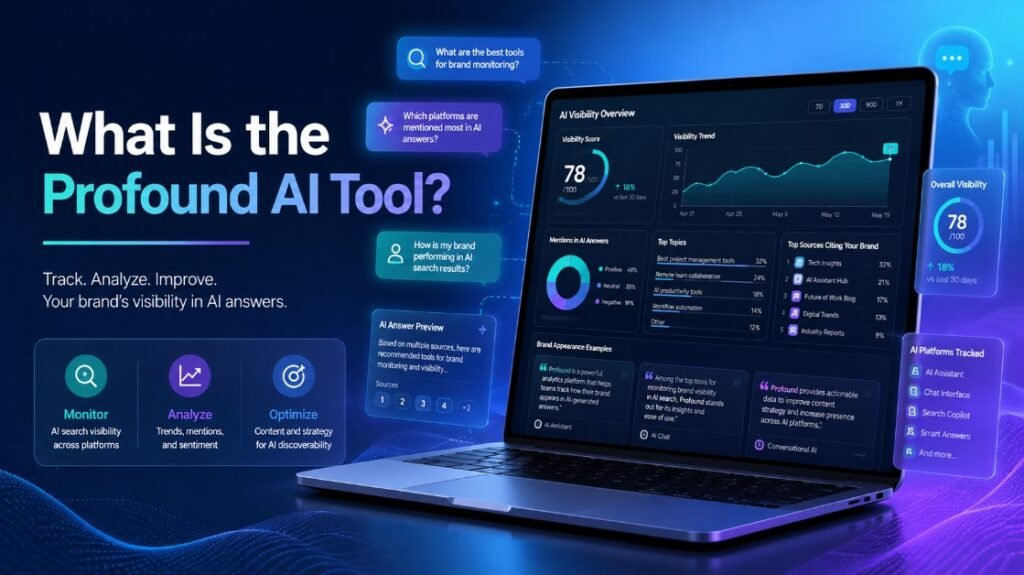
Profound is not a chatbot, writing assistant, or general AI productivity app. It is an AI-search visibility platform for companies that want to know when, where, and how their brands appear in answers produced by ChatGPT, Perplexity, Google AI Overviews, Gemini, Claude, Copilot, Grok, DeepSeek, and other answer engines.
My direct assessment: Profound is one of the more serious tools in this emerging category. It provides much more than a dashboard of random ChatGPT mentions. But it is useful only when you have enough content, customer demand, and internal resources to act on the data.
Buying the platform and watching your visibility score move is not a strategy.
Profound AI Tool at a Glance
| Question | Practical answer |
|---|---|
| What is Profound? | An answer engine optimization and AI-search analytics platform |
| What does it monitor? | Brand mentions, citations, position, sentiment, competitors, prompts, AI crawlers, and AI-referred traffic |
| Who is it for? | SEO, content, brand, PR, growth, and enterprise marketing teams |
| Is it a chatbot? | No |
| Does it create content? | Yes, through configurable Profound Agents, but content creation is only part of the platform |
| Does it guarantee AI citations? | No |
| Does it replace Google SEO software? | No |
| Starting price | $99 per month on the current public pricing page |
| Main strength | Connecting AI-answer monitoring with prompt research, source analysis, content workflows, and crawler data |
| Main weakness | The price and complexity can be difficult to justify for small websites |
Profound currently organizes its product around several connected functions: Answer Engine Insights, Prompt Volumes, Agent Analytics, Agents, and Aim. Its public pricing starts at $99 per month for ChatGPT tracking, while broader multi-engine monitoring begins with the Growth plan at $399 per month.
What Is the Profound AI Tool Actually Measuring?
The Profound AI tool measures your visibility inside AI-generated answers.
Suppose a buyer asks:
What are the best project management platforms for a remote software team?
A traditional rank tracker checks whether your page ranks in Google for a keyword such as “project management software.”
Profound examines a different set of questions:
- Did the AI answer mention your company?
- Where did your brand appear in the answer?
- Which competitors appeared before you?
- Was your website cited as a source?
- Which third-party websites influenced the answer?
- Did the answer describe your product accurately?
- Was the description positive, negative, or neutral?
- Does the result change across platforms, topics, locations, or repeated tests?
This type of measurement is usually called AI visibility tracking, answer engine optimization, or generative engine optimization. You may see the abbreviations AEO and GEO used for closely related work.
Profound describes its core Answer Engine Insights product as a way to analyze brand visibility across major consumer answer engines. The company says it runs tracked prompts daily and captures answers from the user-facing browser experience rather than relying only on standard model APIs.
That daily repetition matters. AI platforms can produce different responses when the same prompt is submitted several times. A single manual check may tell you what happened once. It cannot tell you how frequently your brand appears across repeated answers.
Recent research into GEO measurement reaches a similar conclusion: one observation is not enough because AI answers vary across runs, prompt wording, platforms, and time. Visibility should be treated as a distribution based on repeated measurements, not as one fixed ranking position.
Profound Is Not an AI Search Engine
The name causes confusion, so let’s settle this early.
You do not normally open Profound to ask it general questions in the same way you use ChatGPT or Claude. The platform does not compete with those tools as a consumer assistant.
Instead, the Profound AI tool monitors what those assistants say.
Think about the roles involved:
| Product type | What you do with it |
|---|---|
| ChatGPT, Gemini, Claude, or Perplexity | Ask questions and receive answers |
| Google Search Console | Measure how a website performs in Google Search |
| Traditional rank tracker | Track positions for selected Google queries |
| Profound | Measure how brands, competitors, pages, and sources appear in AI-generated answers |
| Content optimization tool | Improve a page before or after publication |
Profound also offers content creation and automation features, but its defining purpose is AI-search intelligence. Calling it simply an “AI writing tool” misses most of the product.
How the Profound AI Tool Works
The platform’s workflow becomes easier to understand when you follow one prompt from research to action.
1. You choose topics and prompts to monitor
You begin with the questions potential customers might ask an AI assistant.
For a cybersecurity company, these prompts might include:
- What is the best endpoint security software for a small business?
- Which cybersecurity platforms support remote teams?
- What are the best alternatives to CrowdStrike?
- How can a company protect employee laptops?
- Which endpoint protection tools have transparent pricing?
Profound groups related prompts into broader topics. You can add, edit, disable, or replace the recommended prompt set.
Do not rush this step. A poor prompt set produces a misleading report.
If you monitor only branded questions such as “Is Company X good?”, your visibility may look excellent. Buyers who already know the company are likely to trigger branded mentions. That does not show whether the company appears during non-branded product discovery.
Profound recommends combining keyword research with input from customers, sales teams, customer success staff, and other people who hear real buying questions.
2. Profound runs the prompts across selected answer engines
The platform submits the tracked prompts to supported AI systems and records the answers.
According to Profound, prompts are tested daily. Its Starter plan tracks ChatGPT, while its Growth plan currently includes ChatGPT, Perplexity, and Google AI Overviews. Enterprise configurations can cover additional answer engines.
The repeated runs are essential because an answer engine may mention your brand in one answer and omit it in the next.
3. The platform identifies mentions, positions, citations, and sentiment
Profound then converts the collected responses into metrics.
It can show:
- how often your brand appears;
- how often competing brands appear;
- the average order of brand mentions;
- which domains are cited;
- which pages receive citations;
- whether an answer describes the brand positively or negatively;
- which topics produce strong or weak visibility;
- how results change over time.
Now you have something more useful than “ChatGPT mentioned us today.”
You have a pattern.
4. You inspect the sources influencing AI answers
This is where the Profound AI tool becomes particularly useful for SEO and PR teams.
An AI assistant might recommend your competitor because it repeatedly cites:
- a software comparison website;
- a Reddit discussion;
- a trade publication;
- a customer review platform;
- a competitor’s documentation page;
- an analyst report;
- a detailed product comparison.
The immediate response should not always be “publish another blog article.”
Perhaps the missing source is independent. In that case, updating your own website may not be enough. You might need accurate listings, stronger digital PR, more customer reviews, better documentation, or inclusion in a trusted industry comparison.
Profound’s Citations reporting is designed to reveal which domains and pages are being used as sources for monitored prompts.
5. You connect the findings to content or outreach work
Once you find a visibility gap, decide what kind of action fits it.
For example:
- Missing product information may require a clearer product page.
- Incorrect pricing may require an updated pricing page in crawlable HTML.
- Poor comparison visibility may require a dedicated alternatives page.
- Weak authority may require third-party coverage.
- Repeated support questions may justify a new help document.
- Unclear positioning may require more precise product descriptions.
- Negative sentiment may require product, support, or reputation work rather than SEO copy.
Profound’s newer Aim product is designed to turn signals from AI visibility, sales conversations, content performance, prompt demand, and other sources into prioritized marketing projects. The company gives examples such as correcting outdated integration information, creating a missing migration guide, improving a JavaScript-dependent pricing page, or pursuing citations from third-party sources.
6. You measure what changed
After publishing or updating content, watch whether:
- citations increase;
- visibility improves;
- average mention position changes;
- AI crawlers access the page;
- more AI-referred visitors arrive;
- those visitors complete meaningful actions.
Without this final step, you are just producing more content.
The Main Profound Metrics You Need to Understand
Profound contains a lot of data. You do not need to stare at every number.
Start with the metrics that answer a specific business question.
| Metric | What it tells you | What it does not prove |
|---|---|---|
| Visibility Score | The percentage of tracked responses in which your brand appears | That all potential customers see your brand |
| Share of Voice | Your mentions compared with selected competitors | Revenue, market share, or customer preference |
| Average Position | Where your brand tends to appear among the brands mentioned | A permanent ranking |
| Citation Share | How often your domain is cited in the tracked answers | That users clicked the citation |
| Sentiment | How the answers describe your brand | The opinion of the whole market |
| Prompt Volume | Estimated demand for AI conversation topics or terms | An exact count of every prompt submitted worldwide |
| AI crawler activity | Which identified AI bots access your pages | That the crawled content will be cited |
| AI referral traffic | Human visits attributed to AI platforms | That every AI-influenced customer clicked an AI link |
Profound defines Visibility Score as the percentage of mentions across the responses being tracked. Share of Voice compares a brand’s mentions with competitor mentions, while Average Position estimates where the brand appears within relevant answers.
Notice the repeated phrase: tracked responses.
Your score depends on the prompts, platforms, regions, languages, competitors, and time period included in the project. Change the prompt set and you change the measurement environment.
That is not a flaw unique to Profound. It is a basic condition of AI visibility measurement.
The Most Important Profound Features
Answer Engine Insights monitors brand visibility
Answer Engine Insights is the central monitoring component of the Profound AI tool.
It helps you analyze:
- brand visibility;
- competitor visibility;
- citations;
- share of voice;
- mention position;
- response sentiment;
- topic-level performance;
- platform-level performance;
- changes over time.
The useful part is segmentation. A combined visibility score may hide what is happening.
Perhaps your brand performs well in ChatGPT but poorly in Google AI Overviews. Maybe it appears for educational prompts but disappears from commercial recommendations. You might lead in one product category and lose badly in another.
The combined score is where you begin. The segmented data is where you find work.
Prompt Volumes shows what people ask AI systems
Traditional keyword tools are based mainly on search engine queries. AI prompts are often longer, more detailed, and more conversational.
Someone may search Google for:
CRM software
The same person could ask an AI assistant:
Which CRM is easiest for a five-person consulting company that needs email automation but does not have a dedicated salesperson?
Profound Prompt Volumes is designed to identify topics, prompt patterns, estimated demand, intent, and audience differences across AI conversations. The platform says its data begins with prompts obtained through double opt-in consumer panels, after which statistical modeling is used to correct demographic and geographic biases and estimate broader volumes.
That wording matters.
Prompt Volume should be treated as modeled market intelligence, not as a complete record of every conversation taking place inside every AI platform.
Profound reports that the data is anonymized, aggregated, cleared of personally identifiable information, and refreshed weekly with less than one week of typical latency. Current regional availability includes countries such as the United States, Canada, the United Kingdom, Germany, France, Spain, Brazil, Italy, Australia, and South Korea.
Agent Analytics tracks AI crawlers and referred visitors
Getting mentioned in an AI answer is one part of the process. You may also want to know whether AI systems access your content and whether human users arrive from AI platforms.
Agent Analytics uses server or infrastructure data to identify AI crawler activity. It can also connect with analytics systems to examine AI-referred human traffic and conversions.
Profound lists integrations with services such as Cloudflare, AWS, Fastly, Google Cloud, Netlify, Vercel, WordPress, Shopify, and Google Analytics. It says the system uses server logs rather than depending entirely on browser-based JavaScript tracking.
This can answer questions such as:
- Which AI bots crawled the site?
- Which sections did they access?
- How frequently did they return?
- Which pages are receiving AI citations?
- Are visitors arriving from AI assistants?
- Do those visitors register, request a demo, or purchase?
Do not combine these events into one assumption.
A crawler visit does not guarantee a citation. A citation does not guarantee a click. A click does not guarantee a conversion.
Profound Agents automates research and content workflows
Profound Agents is the platform’s no-code workflow system.
Teams can use templates or connect steps for:
- page scraping;
- prompt analysis;
- competitor research;
- content briefs;
- FAQ generation;
- content refreshing;
- new article production;
- API calls;
- publishing workflows.
The platform includes templates for content refreshes, competitive research, AEO-focused FAQs, and net-new content creation. Profound also says its Agents can analyze frequently cited pages and recommend formats based on what answer engines currently cite for a topic.
Useful? Yes.
Safe to publish without review? No.
A generated FAQ may be structurally clear and still contain a weak claim, vague answer, outdated product detail, or sentence that nobody at the company would willingly say. Human review remains necessary, especially for health, finance, law, security, pricing, and product comparisons.
Aim recommends marketing projects
Aim moves Profound closer to a planning and execution platform.
Instead of showing only that your visibility is low, it attempts to identify specific work such as:
- publish a missing comparison page;
- correct inaccurate brand facts;
- update old documentation;
- make pricing information easier for crawlers to access;
- answer recurring sales objections;
- pursue third-party citations;
- document a customer result;
- improve a page already receiving AI crawler attention.
This is a sensible direction. Marketing teams rarely suffer from a complete absence of data. They suffer from too many dashboards and weak prioritization.
Still, a recommendation should be challenged before becoming a task. Ask whether the problem affects a valuable customer segment, whether the supporting data is strong enough, and whether your team can measure the result.
A Hypothetical Profound AI Scenario
Imagine you manage SEO for an invoicing platform called ClearBill.
Your team tracks this prompt:
What is the best invoicing software for European freelancers who need multiple currencies?
ClearBill appears in only 8 percent of tracked answers. Two competitors appear in more than 50 percent.
You inspect the citations and find that AI systems repeatedly use three sources:
- A comparison article that has not reviewed ClearBill.
- A Reddit thread where users discuss multicurrency fees.
- A competitor’s documentation page with a detailed currency table.
The wrong response is to publish five generic articles about “the future of invoicing.”
A stronger plan would be:
- Create a factual multicurrency documentation page.
- Display supported currencies, conversion rules, fees, and limitations in accessible HTML.
- Add a direct comparison to relevant product pages.
- Contact the independent publication with accurate product information.
- Monitor the Reddit discussion without posting disguised promotional comments.
- Recheck citations, visibility, crawler activity, and qualified visits over the next several weeks.
The Profound AI tool does not execute all of that judgment for you. It helps you identify why the brand may be absent and gives you evidence for choosing the next action.
Profound Compared With Other Ways to Track AI Visibility
| Option | Best use | Main advantage | Main limitation |
|---|---|---|---|
| Profound | Dedicated company-wide AEO programs | Deep monitoring, prompt data, citations, Agents, and crawler analytics in one platform | Cost and operational complexity |
| Traditional SEO suite with AI features | Teams already managing SEO in one system | Google SEO and AI visibility can be reviewed together | AI-specific analysis may be less central to the product |
| Lightweight AI visibility tracker | Small teams testing a limited prompt set | Lower entry cost and simpler setup | Fewer integrations, workflows, and enterprise controls |
| Manual ChatGPT or Gemini checks | Initial exploration | Free and immediate | Results are inconsistent, difficult to repeat, and impossible to scale reliably |
| Custom internal monitoring | Companies with technical and data teams | Complete control over prompts, storage, and analysis | Expensive to build and maintain |
Profound’s current plans clearly position it above basic monitoring tools. Starter costs $99 per month and tracks 50 prompts in ChatGPT. Growth costs $399 per month and tracks 100 prompts across three answer engines. Enterprise plans provide customized prompt, platform, language, regional, security, and support options.
The deciding question is not “Which dashboard has the most charts?”
Ask what happens after you find a visibility gap.
A small team may only need affordable monitoring and a spreadsheet. A large brand may need international segmentation, competitor analysis, security controls, server-log integrations, content automation, and reporting for several departments.
Profound makes more sense in the second situation.
What the Profound AI Tool Cannot Tell You
It cannot give you one permanent AI ranking
AI answers are probabilistic and can change when:
- the prompt wording changes;
- a follow-up question is added;
- the user’s context differs;
- the platform changes its retrieval system;
- available web sources change;
- an answer is generated again;
- the model or product is updated.
Treat Average Position as an aggregated observation, not as the equivalent of a fixed Google ranking.
It cannot guarantee that content changes caused a visibility increase
Suppose your citation share rises after you update an article.
The update may have helped. But other things may also have changed:
- a competitor page disappeared;
- an AI platform changed its source selection;
- new third-party coverage appeared;
- the prompt sample changed;
- the underlying model was updated;
- normal answer variation produced a temporary increase.
For a stronger evaluation, compare several prompts, repeated measurements, relevant control pages, multiple platforms, and a sufficiently long time period.
A 2026 review of GEO research warns that the evidence for durable, cross-platform optimization effects remains limited. The review argues that discoverability, citation, prominence, factual use, and downstream business outcomes should be measured separately rather than compressed into one visibility claim.
It cannot turn weak positioning into strong recommendations
AI systems can only work with the information available to them.
If your product has confusing pricing, thin documentation, few credible reviews, unclear use cases, and no independent coverage, the problem is not simply a lack of AEO formatting.
You may need to improve the product information itself.
It cannot prove commercial value with visibility alone
More mentions sound good. They may even look impressive in a report.
But ask tougher questions:
- Did qualified visitors arrive?
- Did branded searches increase?
- Did sales prospects mention AI discovery?
- Did demo requests improve?
- Did the brand begin appearing for high-value buying questions?
- Did the answers become more accurate?
- Did revenue or assisted conversions change?
Visibility is an intermediate metric. Do not present it as revenue.
It cannot replace human editorial judgment
Profound Agents can accelerate research, briefing, formatting, and content production. They cannot take responsibility for what your company publishes.
Someone still needs to check:
- factual accuracy;
- source quality;
- product details;
- legal and compliance risks;
- brand voice;
- search intent;
- originality;
- whether the page deserves to exist.
That last check is easy to skip. Do not skip it.
Common Mistakes When Using Profound
Tracking prompts that are too broad
“Best software” may be relevant to thousands of products.
A narrower prompt such as “best scheduling software for a private dental clinic with three locations” gives you a clearer audience, competitor set, and content problem.
Tracking only the prompts where you already perform well
This creates a flattering report and a weak strategy.
Include:
- discovery prompts;
- alternatives prompts;
- comparison prompts;
- problem-based prompts;
- pricing questions;
- risk and objection questions;
- implementation questions;
- prompts where important competitors dominate.
Treating every missing mention as a content gap
Sometimes your website needs a new page.
Sometimes you need a review, expert mention, customer discussion, product listing, updated documentation, or stronger product evidence.
Look at the cited sources before assigning another article.
Reporting visibility without explaining the prompt set
A 40 percent visibility score has no meaning without context.
Report:
- which prompts were tracked;
- how they were selected;
- which platforms were included;
- what region and language were used;
- which competitors were compared;
- how many responses were analyzed;
- what changed during the period.
Automating publication too early
First build a reliable editorial workflow. Then automate the repeatable parts.
Otherwise, you will produce low-value pages faster and spend even more time correcting them.
Practical Checklist: Do You Need Profound?
The Profound AI tool is likely worth testing when most of these statements are true:
- Potential customers use AI assistants for research or product discovery.
- Your brand competes in a category where recommendations influence purchases.
- You have enough non-branded prompts to monitor.
- Your team publishes, updates, or distributes content regularly.
- You can act on source and citation gaps.
- You need competitor-level AI visibility reporting.
- You need more than occasional manual checks.
- You can connect AI visibility to traffic, leads, sales, or another business outcome.
- Someone will own the platform and review the data consistently.
- The cost is reasonable compared with the value of the decisions it supports.
Profound may be excessive when:
- your website has only a few pages;
- you do not yet have basic analytics;
- your audience rarely uses AI systems for discovery;
- nobody can implement the recommendations;
- you only want to check five prompts occasionally;
- your primary SEO problems are crawling, indexing, page quality, or weak conversion;
- you expect the software to generate results without content, PR, technical, or product work.
Be honest here. A sophisticated measurement platform does not repair an unfinished marketing operation.
A Step-by-Step Plan for Testing Profound
Step 1: Select one commercially important topic
Do not begin with the entire business.
Choose one product category, audience segment, or customer problem that already matters to revenue.
Step 2: Build a mixed prompt set
Include approximately:
- discovery prompts;
- comparisons;
- alternatives;
- use-case questions;
- pricing questions;
- implementation concerns;
- trust and risk questions.
Avoid changing the set every few days.
Step 3: Define competitors before reviewing results
Include direct competitors, category leaders, and unexpected companies that appear in AI answers.
This prevents you from choosing competitors only after seeing who performs well.
Step 4: Record your baseline
Capture visibility, citations, average position, sentiment, source domains, AI crawler activity, and AI-referred traffic where available.
Keep the original export.
Step 5: Choose two or three evidence-based actions
For example:
- Improve a product comparison page.
- Publish missing technical documentation.
- Correct outdated information on an authoritative third-party profile.
Do not launch 30 changes at once. You will have no idea which action mattered.
Step 6: Annotate every meaningful change
Record publication dates, page updates, PR placements, review campaigns, major product announcements, and changes to tracked prompts.
Your future report depends on this discipline.
Step 7: Evaluate business and visibility outcomes separately
Check whether AI mentions changed.
Then check whether traffic, leads, conversions, sales conversations, or customer discovery changed.
Those are related questions, not identical ones.
Step 8: Decide whether to expand
After the pilot, decide whether broader monitoring will improve decisions.
Expand only when the first project produces useful actions, not because the dashboard looks impressive.
Profound AI Pricing
As of August 2026, Profound’s public brand pricing includes three main levels:
| Plan | Current listed price | Main limits and features |
|---|---|---|
| Starter | $99 per month | ChatGPT, 50 tracked prompts, 100 Agent credits, one seat |
| Growth | $399 per month | Three answer engines, 100 tracked prompts, 400 Agent credits, three seats |
| Enterprise | Custom | Broader engine support, customized prompt tracking, multiple companies, SSO, dedicated support, API access, and tailored limits |
The pricing page states that annual billing includes two months free. Agent usage follows a credit system, and more complex workflows consume more credits.
Profound also offers a free AEO report and a public Profound Index. The Index ranks brands within selected industries based on how frequently they appear in AI search, using anonymized prompt data from double opt-in consumer panels. It is updated weekly, while the complete platform supports customized brand tracking.
Pricing can change. Check the current plan details before using exact figures in a purchasing decision or published comparison.
FAQ About the Profound AI Tool
What is the Profound AI tool used for?
The Profound AI tool is used to measure and improve a brand’s presence in AI-generated answers. It tracks mentions, citations, competitors, sentiment, prompt performance, AI crawler activity, and AI-referred traffic.
Is Profound the same as ChatGPT?
No. ChatGPT is an AI assistant that answers user questions. Profound monitors how brands and sources appear in ChatGPT and other answer engines.
Is Profound AI free?
The full platform is paid. Profound currently provides a free AEO report and public Profound Index, while its listed paid plans begin at $99 per month.
Can Profound improve my ChatGPT ranking?
Profound can identify missing mentions, citation gaps, inaccurate descriptions, competitor advantages, and content opportunities. It does not directly control ChatGPT’s answers and cannot guarantee a particular position or citation.
Does Profound replace Ahrefs, Semrush, or Google Search Console?
No. Traditional SEO platforms measure areas such as Google rankings, backlinks, technical health, keywords, impressions, and clicks. Profound specializes in AI-answer visibility. A company may use both types of software because they answer different questions.
What are Profound Agents?
Profound Agents are configurable automated workflows for tasks such as research, content briefs, FAQ creation, competitive analysis, content refreshing, and publishing. They can use web scraping, model prompts, Profound data, and API steps.
What is Prompt Volumes in Profound?
Prompt Volumes estimates what people ask AI assistants, how topics relate, which intents appear, and how demand differs by platform or audience. The data is based on anonymized consumer-panel conversations combined with statistical modeling.
Can Profound track AI bots visiting my website?
Yes. Agent Analytics can use server and infrastructure integrations to identify verified AI crawlers, analyze the pages they access, and connect AI activity with human referral traffic.
Is Profound suitable for a small business?
It can be, particularly when AI recommendations already affect customer discovery. But the price and depth may be unnecessary for a small company that only needs limited monitoring. Start with a narrow test and judge the platform by the decisions it improves.
The Honest Verdict on Profound
Profound is not useful because it gives marketing teams another score.
It is useful when it shows that a competitor dominates an important buying question, identifies the sources causing that advantage, reveals what your brand is missing, and helps your team choose a measurable response.
That is a demanding standard. It should be.
The Profound AI tool is a strong option for companies that already have an active SEO, content, PR, or growth program and now need structured AI-search intelligence. Its combination of repeated answer monitoring, prompt research, citation analysis, crawler analytics, competitor data, and automated workflows is substantially more capable than checking ChatGPT manually.
For a small website with limited resources, it may be too much software for too little action. For a larger brand trying to understand AI-driven discovery across products, markets, and platforms, it can support decisions that ordinary rank tracking cannot.
Use Profound when you are ready to investigate, publish, correct, distribute, and measure.
Not when you are merely curious about a dashboard.